

Every summer, borewell water levels fall. The pump that gave full water in December gives a trickle by April, and summer is when the most borewell motors burn. When the water drops below the pump, the motor runs dry, and a submersible motor needs flowing water to stay cool. Here is how to spot a falling water level, how to help the borewell, and how to make sure your motor survives the summer.
Why borewell water goes down in summer
- Less rain recharges the ground, so the water table falls.
- Every farm around you is pumping more for the crops.
- Pumps run longer hours, so the borewell has less time to refill between runs.
- Neighbouring borewells draw from the same water.
A borewell that kept up with your pump in winter may only keep up for an hour or two in summer.
Signs your borewell water level is falling
- Water comes in spurts, mixed with air.
- Full water at the start, then less and less as the motor runs.
- The current (amps) on the starter’s display is lower than normal: a pump without enough water does less work.
- The starter shows Dry Run Trip more often.
If you see these, don’t keep starting the motor again and again. Each run without water heats the motor further. Read motor running but no water for other causes to rule out.
How to protect your motor through the summer
1. Use a starter with dry run protection
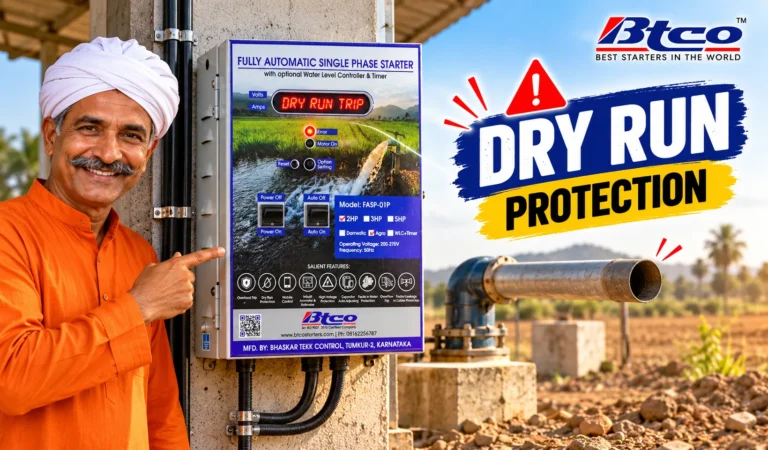
This is the most important step. A BTCO starter has dry run protection built in. It watches the motor’s current and, when the pump runs out of water, shows Dry Run Trip and stops the motor before it burns. No sensor needs to go into the borewell.
2. Set the right dry restart time
After a dry run trip, a BTCO starter waits for the dry restart time you set, then starts the motor again. In summer, set a longer time, so the borewell has enough time to refill before the next run. If it still trips often, make it longer again.
3. Run the motor in shorter cycles
A weak borewell gives more water in total if you pump in short runs with rests in between. The cyclic timer does this by itself: ON for a set time, OFF for a set time, again and again, so the water level can recover while the motor rests.
4. Water at the right time of day
Watering in the early morning or evening loses less water to the heat. An RTC timer starts the motor at the same time every day. With the BTCO GSM Module you can also switch the motor and change timers from your phone, and get an alert the moment the starter trips on dry run.
5. Check the pump depth before the peak of summer
If your water level has fallen a lot over the years, ask your pump mechanic whether the pump should be lowered, and whether the pump suits the new depth. See how much HP motor your borewell needs.
Help the borewell refill: recharge
Over the long term, the best answer to falling water is borewell recharge: guiding rainwater back into the ground near your borewell.
- A recharge pit near the borewell, filled with layers of boulders, gravel and sand, lets rainwater soak down and filters it.
- Farm ponds and bunds hold rainwater on your land so it soaks in instead of running off.
- Drip irrigation and mulching use less water, so the borewell lasts longer each day.
Do recharge work before the monsoon, so the rains fill it. Your local agriculture or watershed office can advise on the right design for your soil.
Frequently asked questions
Why does my borewell water go down in summer?
Less rain recharges the ground, every farm pumps more, and pumps run longer, so the water table falls and the borewell has less time to refill between runs.
How do I know my borewell water level is low?
Water comes in spurts with air, it reduces as the motor runs, the current on the starter’s display is lower than normal, and the starter shows Dry Run Trip more often.
How do I protect my submersible motor when the borewell runs dry?
Use a starter with dry run protection, which stops the motor when the pump runs out of water. Set a longer dry restart time in summer so the borewell can refill, and use a cyclic timer to pump in short runs with rests.
What dry restart time should I set in summer?
Longer than in winter. Start with a longer wait and increase it if the starter still trips on dry run often. The goal is to give the borewell enough time to refill before the motor starts again.
How can I increase my borewell water level?
Recharge it: build a recharge pit near the borewell filled with boulders, gravel and sand, keep rainwater on your land with farm ponds and bunds, and save water with drip irrigation. Do the work before the monsoon.
Does dry run protection need a sensor in the borewell?
No. A BTCO starter detects dry run from the motor’s current, so nothing has to be lowered into the borewell.
Get your motor ready for summer
Call or WhatsApp us with your motor’s HP and your power supply. We’ll suggest the right BTCO starter with dry run protection and timers, or visit your nearest BTCO dealer. Read why submersible motors keep burning.
More videos on our videos page. Follow BTCO Starters on YouTube, Instagram and Facebook.