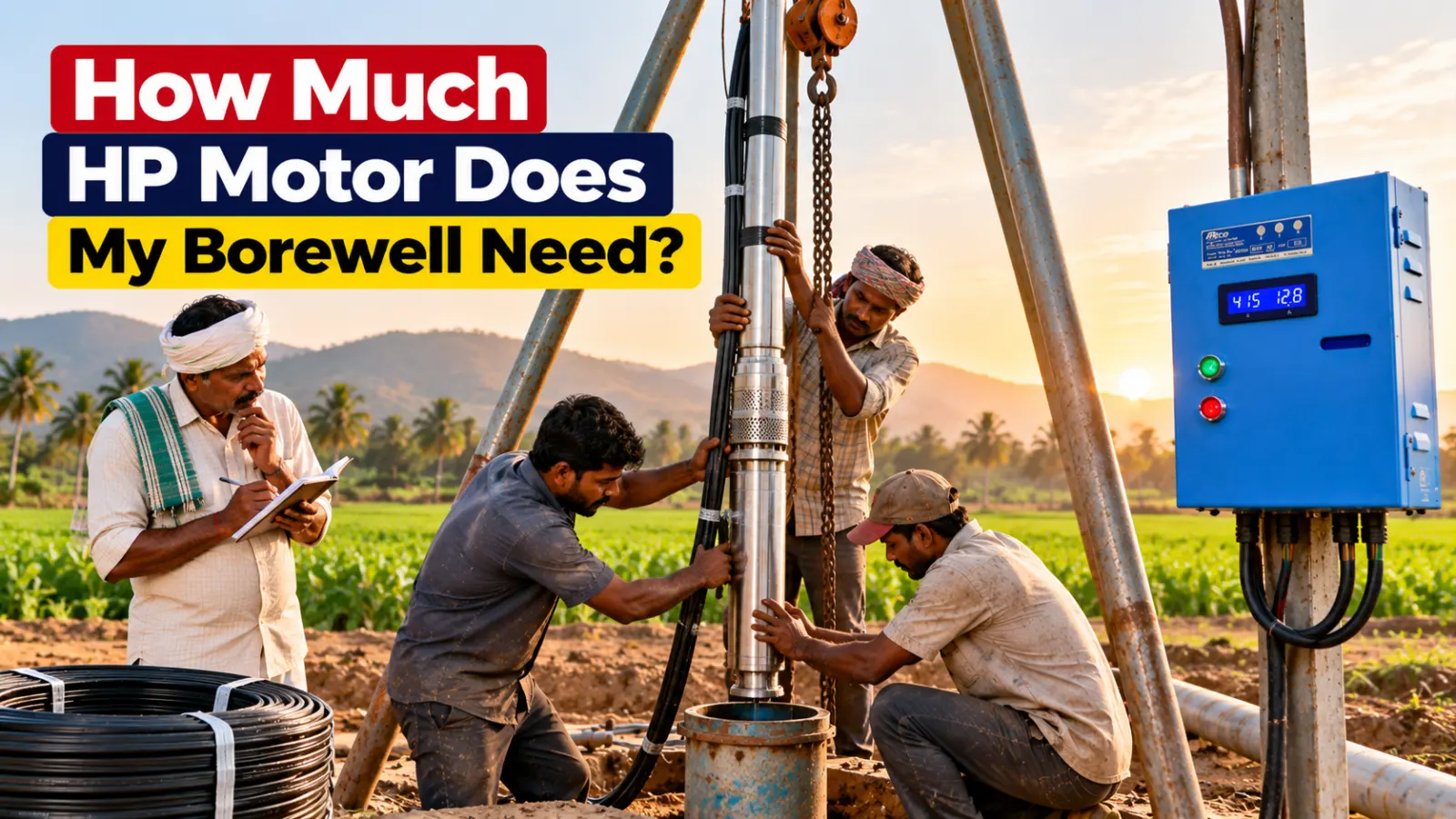
“How much HP motor do I need for my borewell?” is the first question when you drill a new borewell or replace a pump. Too small, and it won’t lift enough water. Too big, and it pulls the borewell dry, wastes power and runs dry until it burns. The right HP depends on four things. Here is how they work together, and which starter goes with each HP.
The 4 things that decide the HP
1. How deep the water is (not how deep the borewell is)
What matters is the depth of the water level while pumping, not the total depth drilled. When the pump runs, the water level inside the borewell falls (drawdown). The pump has to lift water from that level.
2. How high and how far the water has to go
Add the height from the ground to your tank or field, and the friction in the pipes. A long pipeline to a far field, or a tank on a hill, adds a lot. Together with the lifting depth, this is the total head.
3. How much water you need
More water per hour (more litres per minute) needs more power. Drip irrigation for a small plot needs much less than flood irrigation for several acres.
4. How much water the borewell can give (yield)
A borewell can only give so much water per hour. A motor that pumps more than the yield empties the borewell and runs dry. That is why the biggest motor is often the wrong motor. Your driller’s yield test, or how your old pump behaved, tells you the yield.
A simple way to estimate
Pump sellers work it out roughly like this:
- Power needed (HP) ≈ flow (litres per second) × total head (metres) ÷ (76 × pump efficiency)
- Submersible pump sets usually have an efficiency of around 0.4 to 0.6.
Example: 2 litres per second (120 litres per minute) lifted through a total head of 120 metres, with an efficiency of 0.5: 2 × 120 ÷ (76 × 0.5) ≈ 6.3 HP, so a 7.5 HP motor would be chosen.
This is only an estimate. The pump maker’s performance chart for each model shows exactly how much water it gives at each head. Your pump dealer picks the model and number of stages from that chart. Give them your water level, total head, the water you need and the borewell yield.
Please note: this post is general information to help you understand how HP is chosen. It is not a BTCO recommendation. Every borewell is different, so please do your own research, talk to your dealer, who knows motors in practice, and make the final decision yourself.
Bigger is not better
- A motor that pumps faster than the borewell refills will run dry again and again.
- It uses more electricity for the same water.
- A big motor on a weak line pulls the voltage down further.
If your borewell is weak, a smaller motor running longer, or a cyclic timer that rests the borewell between runs, gives more water in the end. Whatever the HP, a starter with dry run protection stops the motor when the water runs out. Read protecting your motor when the water goes down in summer.
Single phase or three phase?
Single phase borewell motors are usually about 2 to 5 HP; above that, three phase. See single phase vs three phase submersible pump.
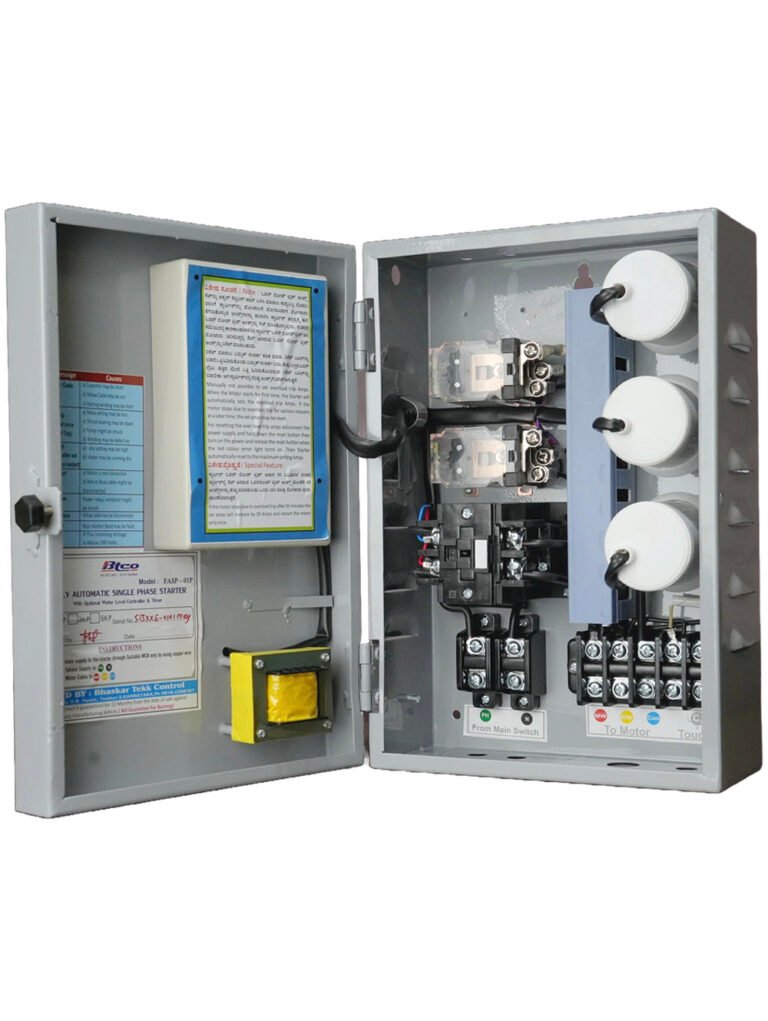
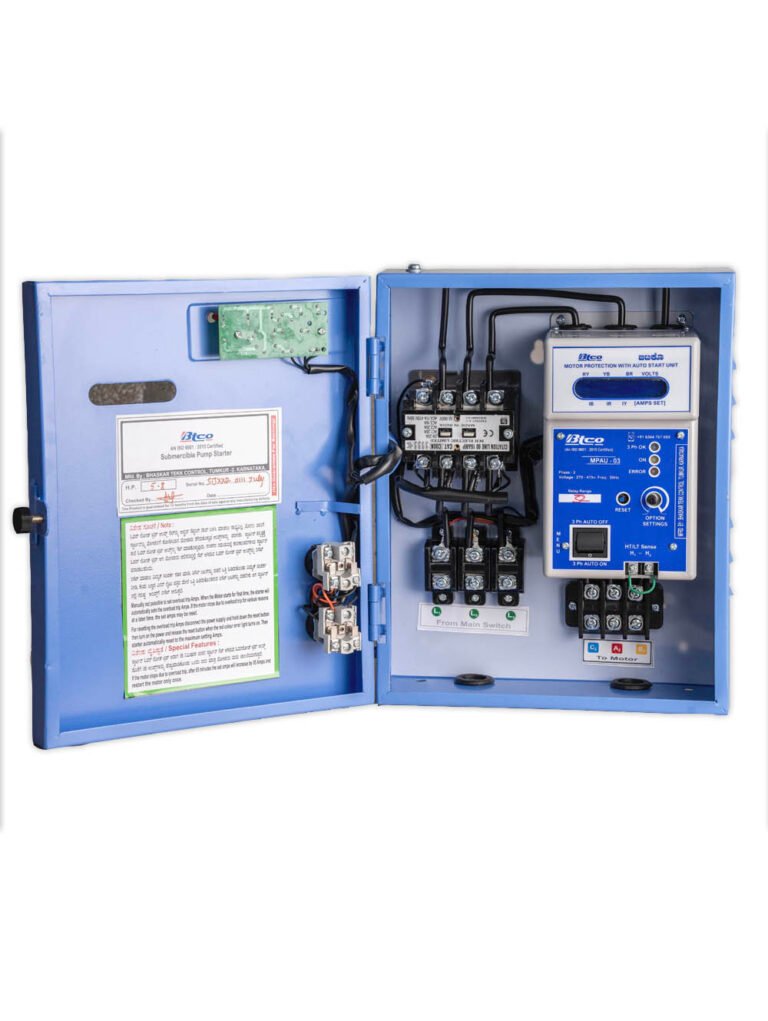
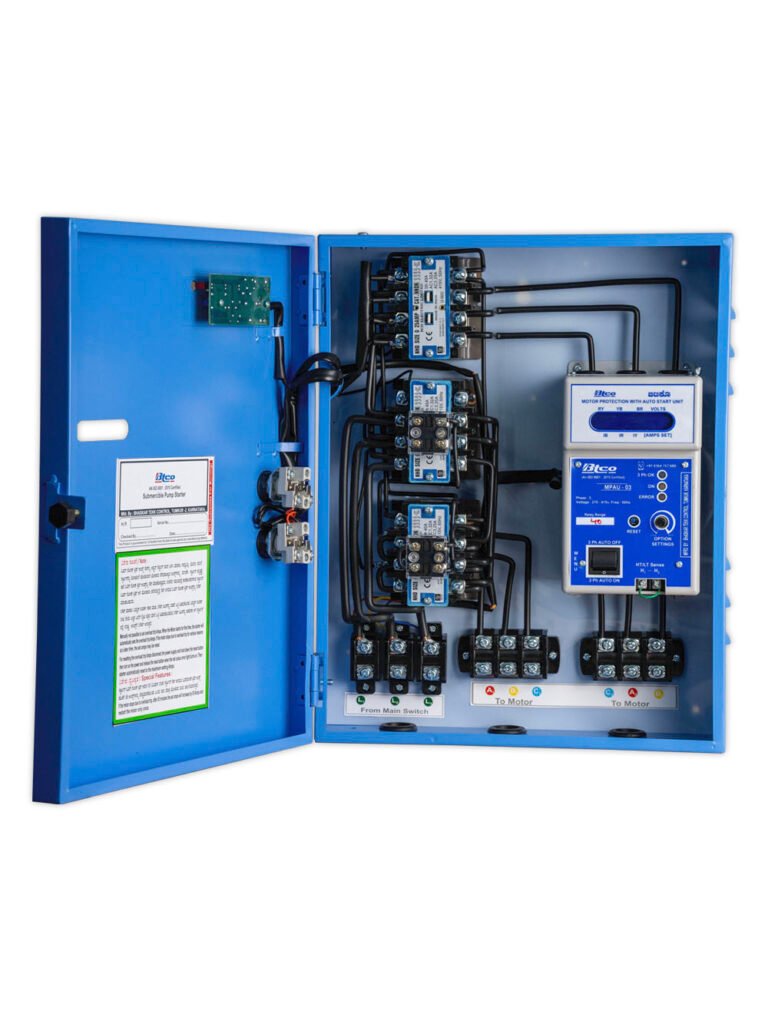
Which BTCO starter for your HP
| Motor | Supply | BTCO starter |
|---|---|---|
| 2–5 HP | Single phase | Single Phase starter |
| 3–10 HP, single cable | 3 phase | DOL starter |
| 7.5–30 HP, double cable | 3 phase | Star Delta starter |
| Up to 10 HP | Juice line, 2 phase or 3 phase | Combined DOL |
| 7.5–25 HP, double cable | 2 phase or 3 phase (juice line up to 10 HP) | Combined Star Delta |
From 7.5 HP, motors come in both single cable and double cable, so check your motor’s cable before choosing. All BTCO starters work with every motor brand, and the overload trip amps are set automatically for your motor. The starter finder picks the right one in a few questions.
Frequently asked questions
How do I calculate the HP of a submersible pump for my borewell?
Roughly, HP is about the flow in litres per second, times the total head in metres, divided by 76 times the pump efficiency (around 0.4 to 0.6). Total head is the pumping water level plus the height and pipe friction to your tank or field. This is only a rough estimate; check with your dealer before you buy.
Does a deeper borewell always need a bigger motor?
Not always. What matters is the depth of the water level while pumping, plus how high and far the water must go, and how much water you need. A deep borewell with a high water level may need less HP than you expect.
Is a bigger HP motor better for my borewell?
No. A motor that pumps faster than the borewell refills will run dry, waste power and can burn. Match the motor to the borewell’s yield.
Which starter do I need for a 7.5 HP motor?
It depends on the cable. A 7.5 HP single cable motor uses a DOL starter; a 7.5 HP double cable motor uses a star delta starter. On juice line or 2 phase, use a Combined starter.
Do BTCO starters work with all motor brands?
Yes. BTCO starters work with submersible motors of all brands, and the overload trip amps are set automatically for your motor.
Ask us before you buy
Call or WhatsApp us with your borewell’s water level, the motor HP you’re considering and your power supply. We’ll tell you which BTCO starter fits, or visit your nearest BTCO dealer.
More videos on our videos page. Follow BTCO Starters on YouTube, Instagram and Facebook.