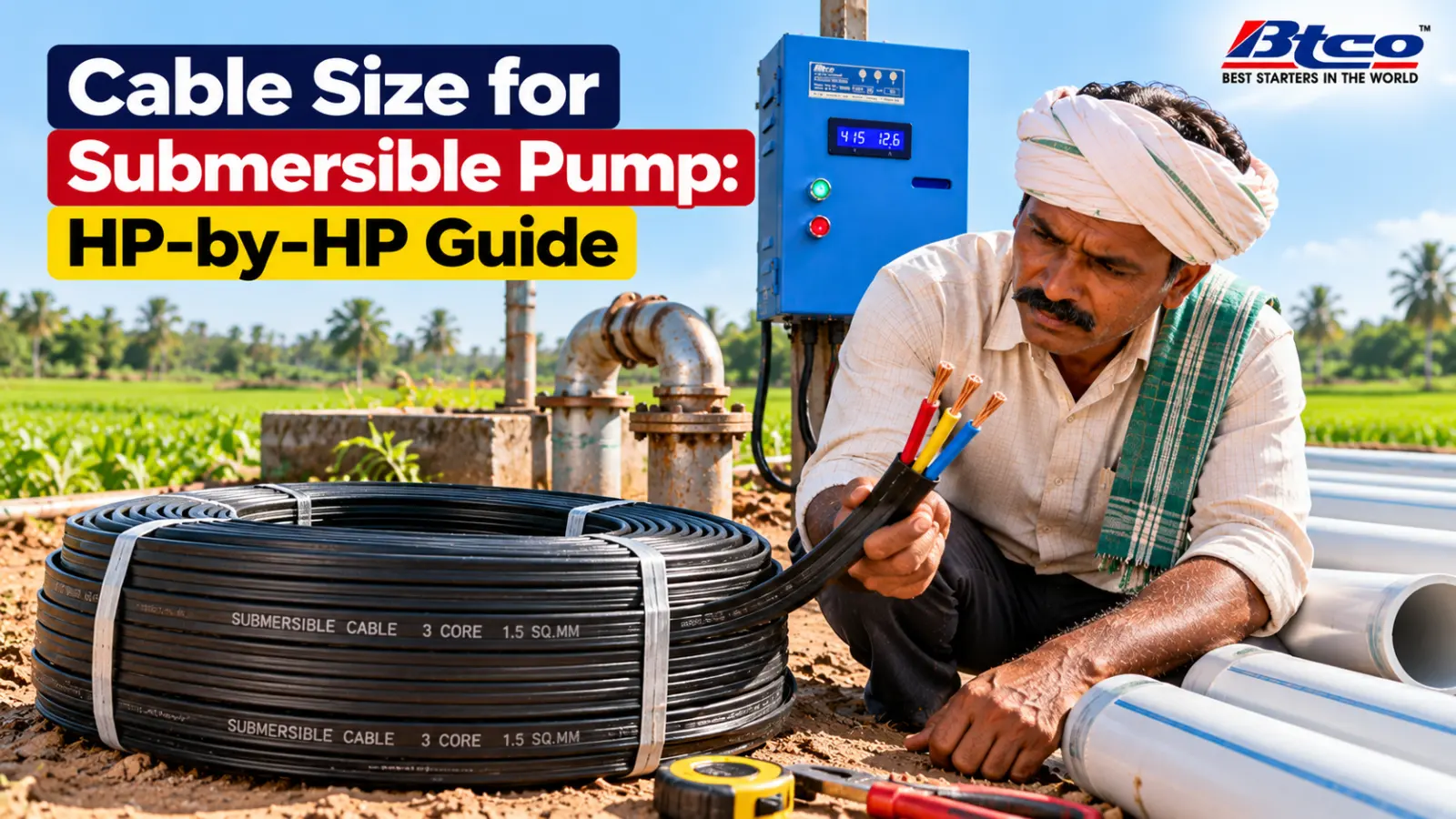
The flat cable that runs down the borewell is easy to forget, and easy to buy too thin to save money. But a cable that is too thin for the motor’s current and the borewell’s depth drops the voltage before it reaches the motor. The motor then pulls more current, runs hot, and burns. Here is how cable size is decided, a general size table by HP, and how to tell if yours is too thin.
Why cable size matters
Every metre of cable has a little resistance. The longer the cable and the more current it carries, the more voltage is lost along the way (the voltage drop). A thicker cable (more sq mm of copper) loses less.
A deep borewell can need a very long cable: the depth where the pump hangs, plus the distance from the borewell to the starter. If the cable is too thin for that length, the motor at the bottom gets low voltage even when the voltage at the starter looks fine. Low voltage makes the motor pull more current and heat up, the same as voltage fluctuation, but all the time.
What decides the cable size
- Motor HP and its full load current: a bigger motor carries more current and needs more copper.
- Total cable length: pump depth plus the distance from the borewell to the starter. The longer the run, the thicker the cable.
- Supply: single phase motors carry more current than three phase motors of the same HP, so they often need a thicker cable.
- Single or double cable: star delta motors use two cables (6 wires), DOL motors one cable (3 wires). See DOL vs star delta.
- Copper and quality: submersible cable should be proper flat submersible cable with copper conductors, rated for use under water.
Cable size by HP: a general guide
The table below gives typical copper flat cable sizes used for borewell motors. It is worked out from the usual voltage drop method (keeping the voltage lost in the cable to about 5%), using a normal full load current for each HP. Cable length means the total run: pump depth plus the distance from the borewell to the starter.
On a phone, swipe the table sideways.
| Motor | Cable length up to about 100 m | About 100 to 200 m |
|---|---|---|
| 3 phase, 3–5 HP | 2.5 sq mm | 4 sq mm |
| 3 phase, 7.5 HP, single cable | 4 sq mm | 6 sq mm |
| 3 phase, 10 HP, single cable | 4 sq mm | 6 sq mm |
| 3 phase, 7.5–10 HP, double cable | 2.5 sq mm (each cable) | 4 sq mm (each cable) |
| 3 phase, 12.5–15 HP, double cable | 4 sq mm (each cable) | 6 sq mm (each cable) |
| 3 phase, 20 HP, double cable | 6 sq mm (each cable) | 10 sq mm (each cable) |
| 3 phase, 25–30 HP, double cable | 6 sq mm (each cable) | 10 sq mm (each cable) |
Single phase motors carry much more current, so they need thicker cable over a shorter length:
| Single phase motor | Cable length up to about 50 m | About 50 to 90 m |
|---|---|---|
| 2 HP | 2.5 sq mm | 4 sq mm |
| 3 HP | 4 sq mm | 6 sq mm |
| 5 HP | 6 sq mm | 10 sq mm |
A few rules of thumb:
- Deeper borewell or a far starter: use the longer-length column, or go one size up.
- Star delta (double cable): both cables must be the same size.
- Replacing the pump at a deeper level: check the cable again; the old one may now be too thin or too short.
- Unsure between two sizes: choose the thicker one. It loses less voltage and runs cooler.
Please note: this table is general information collected from common cable sizing methods. It is not a BTCO recommendation. The right size depends on your motor’s actual current, its maker’s cable chart, the cable quality and your line voltage. Please do your own research, check with your dealer, who knows motors in practice, and make the final decision yourself.
Signs your cable is too thin or failing
- The current (amps) on the starter’s display is higher than normal for your motor.
- The voltage at the starter is fine, but the motor struggles or trips on Overload.
- The cable or its joint at the top is warm after the motor has run.
- The starter shows Check Cable / Kit or Ground / Imbalance.
A BTCO digital starter shows the current on each phase, so a cable problem shows up as numbers before it shows up as a burnt motor.
Cable joints: where most cable faults start
The joint between the motor’s own lead and the drop cable sits under water for years. A poorly made joint lets water in, the insulation weakens, and current starts to leak. Ask for a proper waterproof joint kit, have it made by an experienced mechanic, and test the insulation before lowering the pump. Then have it checked whenever the pump comes out. Good earthing lets the starter’s grounding protection catch leakage early.
The starter catches what the cable hides
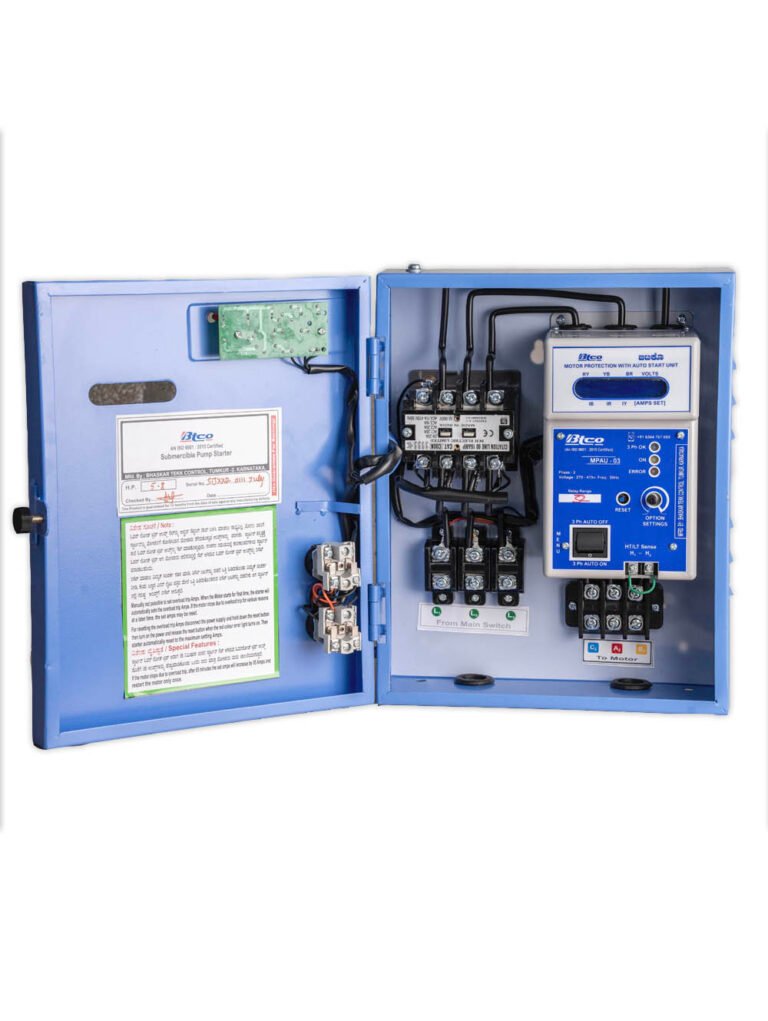
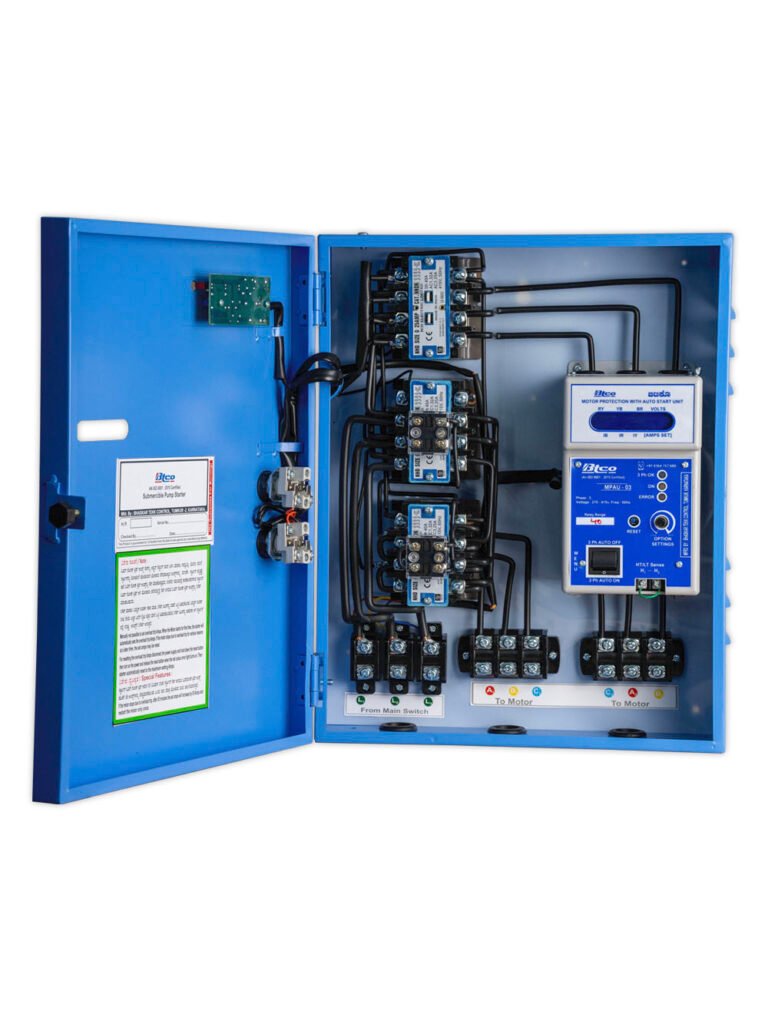
Even with the right cable, joints age and voltage on the line changes. Every BTCO starter trips on current, has cable fault and grounding protection, and also protects against dry run, single phasing and overload, so a cable problem stops the motor before it burns. Read why submersible motors keep burning.
Frequently asked questions
How do I choose the cable size for a submersible pump?
It depends on the motor’s HP, single or three phase, and the total cable length (pump depth plus the distance from the borewell to the starter). As a general guide, a 3 phase 3 to 5 HP motor often uses 2.5 sq mm up to about 100 m, and a 10 HP single cable motor 4 sq mm. Longer runs need a size up. This is general information only; check with your dealer and the motor maker’s chart before you buy.
What happens if the submersible cable is too thin?
The cable loses voltage along its length, so the motor gets low voltage, pulls more current and runs hot. Over time this can burn the motor. You may see higher current on the starter’s display, overload trips, or a warm cable.
Does a single phase pump need a thicker cable?
Usually yes. A single phase motor carries more current than a three phase motor of the same HP, so it often needs more copper. For example, a 3 HP single phase motor often uses 4 sq mm where a 3 HP three phase motor uses 2.5 sq mm.
Why does a star delta motor need two cables?
A star delta motor has six winding leads instead of three, so it uses two three-core cables (a double cable). Both cables must be the same size.
What does Check Cable / Kit mean on a BTCO starter?
The starter found a problem in the motor cable or in the contactor kit inside the starter. Ask an electrician to check the cable and its joints, and the contactor kit.
Check your installation with us
Call or WhatsApp us with your motor’s HP, the pump depth and the distance from the borewell to the starter. We’ll help you check it, or visit your nearest BTCO dealer.
More videos on our videos page. Follow BTCO Starters on YouTube, Instagram and Facebook.