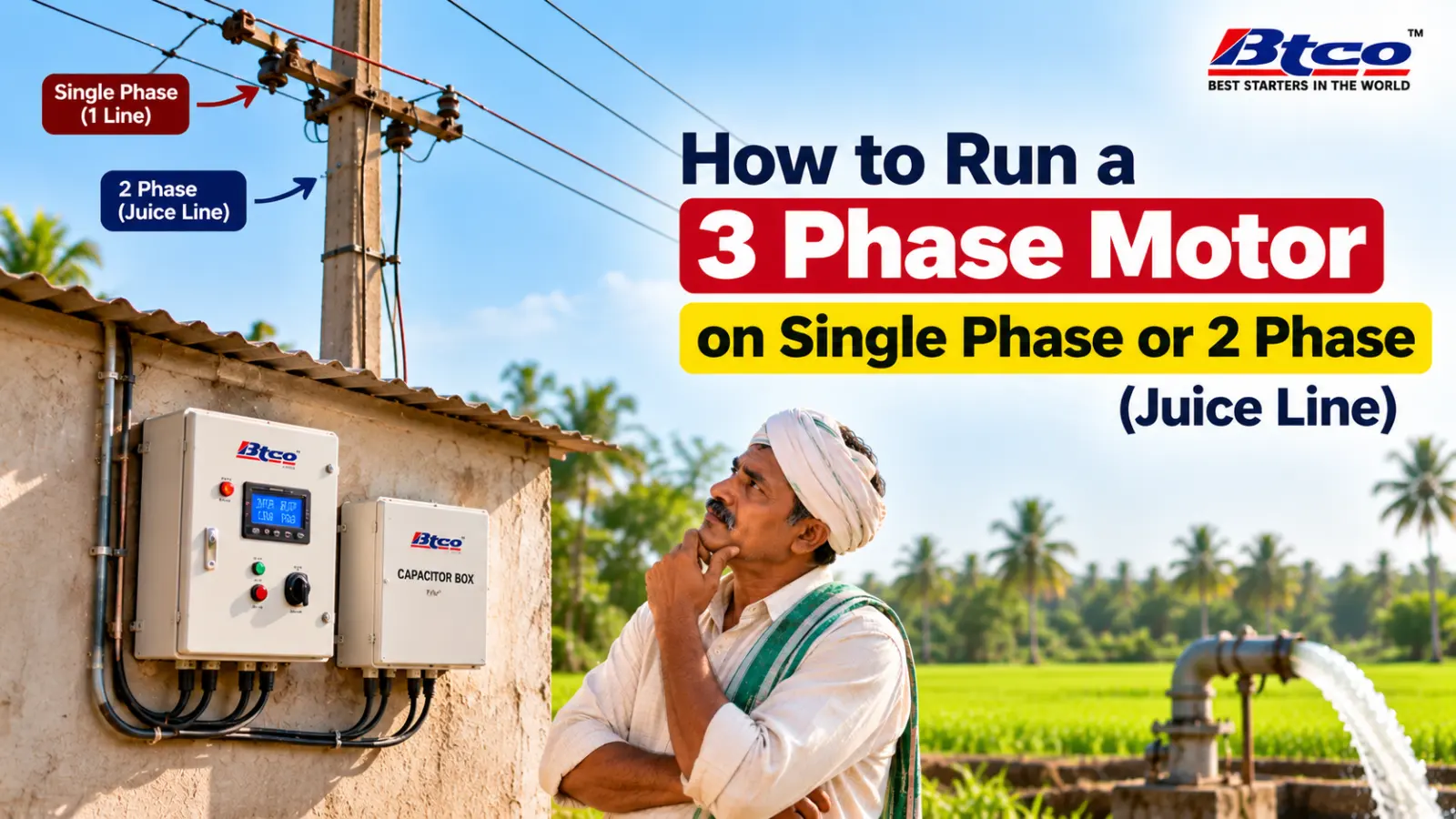
In many villages, the full 3 phase supply comes only for a few hours. The rest of the time the line gives 2 phase, or the juice line (also called the series line or single line). Your borewell motor is 3 phase, so it stops, or worse, it tries to run on what it gets and burns. Here is what these supplies really are, how a 3 phase motor can run on them, and how to do it without burning the motor.
What “single phase”, “2 phase” and “juice line” mean in a village
These words mean something different on a farm line than in a house:
| What farmers call it | What is on the line | Can a 3 phase motor run on it directly? |
|---|---|---|
| 3 phase | All three phases, full voltage | Yes, with a normal 3 phase starter |
| 2 phase | Two live phases, the third missing | No: it hums, pulls heavy current and can burn |
| Juice line / series line / single line | The 3 phase line with one phase at around 300 V and the other two very low | No: same danger |
| Home single phase (230 V) | One phase and neutral, the supply in your house | No. This post is not about the house supply |
A 3 phase motor needs all three phases to turn properly. Given only one or two, it either doesn’t start or runs with very high current in the windings it has, and a motor in that state can burn in minutes. This is the same danger as single phasing.
How capacitors make a 3 phase motor run on 2 phase
Capacitors (farmers often call them condensers) can create the missing phase for the motor, so a 3 phase motor can start and run on 2 phase or on the juice line. That is why the starters that do this are called capacitor starters, condenser starters or phase converter starters.
But wiring capacitors by hand is risky:
- The capacitor values have to suit the motor and the line. Too little and the motor won’t start; too much and the motor runs hot.
- The capacitors must be switched in and out at the right moment, and when the supply changes from juice line to 3 phase.
- A plain capacitor box has no protection: if the borewell runs dry or a capacitor fails, the motor keeps running until it burns.
The safe way: a Combined starter
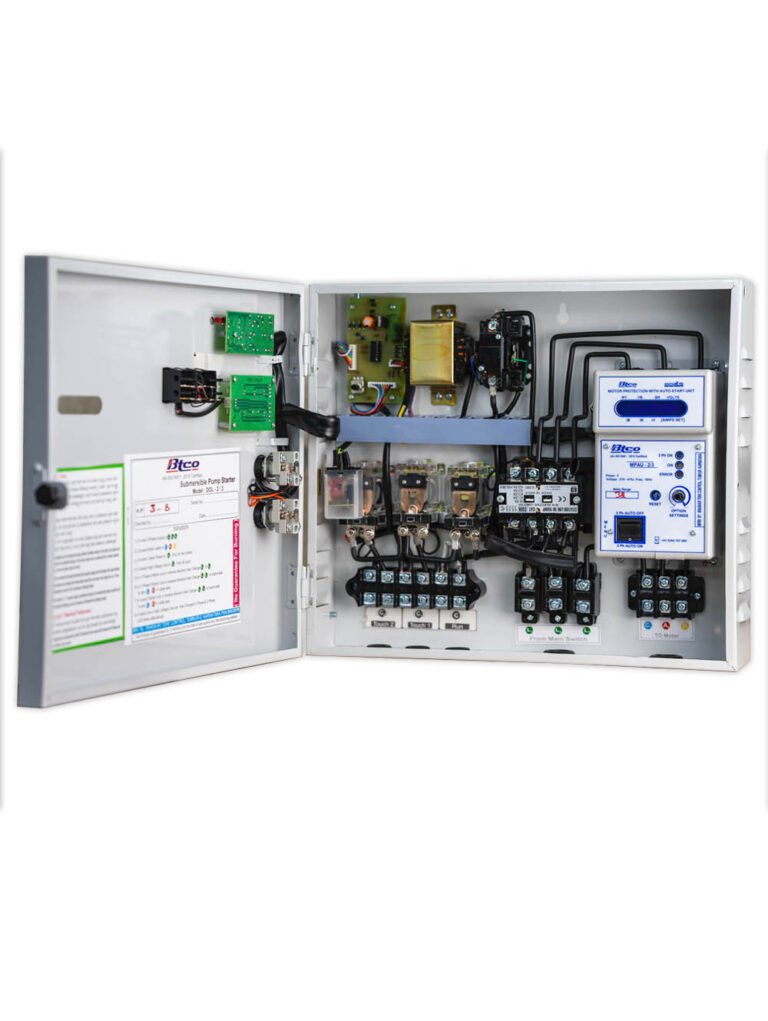
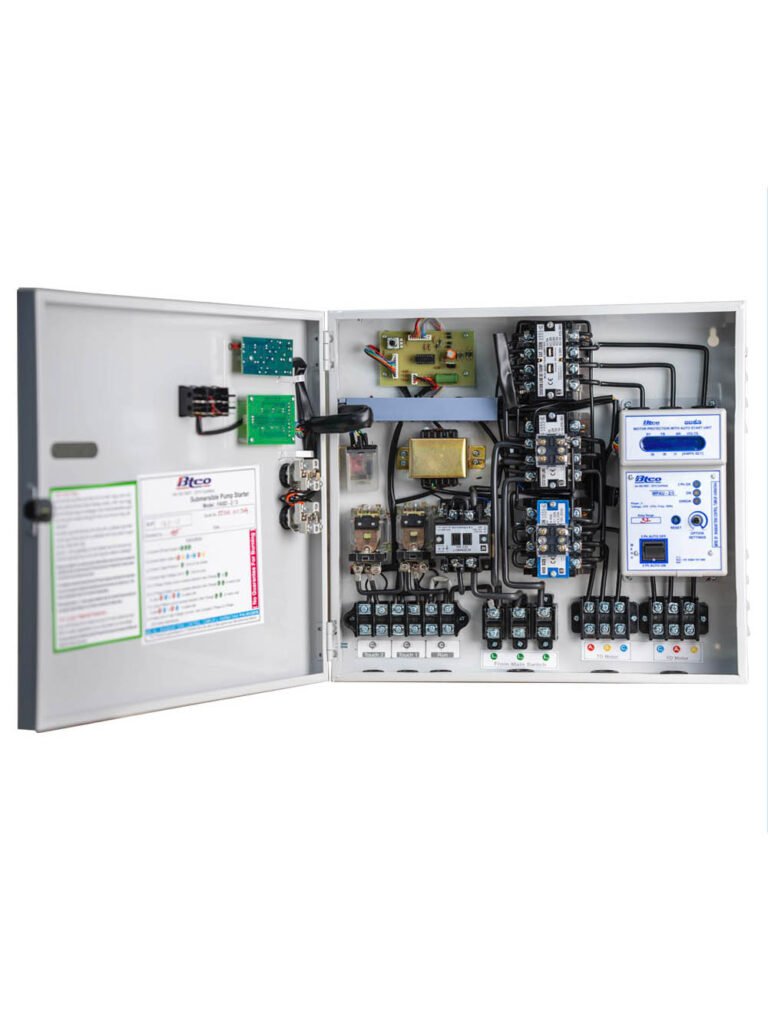
A BTCO Combined DOL starter (the “juice starter”) runs your 3 phase motor on juice line, 2 phase or 3 phase, by itself:
- It sees which supply has come and runs the motor on it. When the full 3 phase comes, it runs the motor on 3 phase.
- It manages the capacitors automatically, and checks them. A capacitor problem shows Check Capacitor on the display.
- If the motor stalls on 2 phase or juice line, it stops it and shows Rotor Lock Trip.
- It keeps all the BTCO protections working: dry run, overload, voltage fluctuation (it trips on current), and single phasing on 3 phase supply.
Which Combined starter for your motor?
| Your motor | Starter | Supply it runs on |
|---|---|---|
| 3 phase, single cable, up to 10 HP | Combined DOL | Juice line, 2 phase or 3 phase |
| 3 phase, double cable, 7.5–10 HP | Combined Star Delta | Juice line, 2 phase or 3 phase |
| 3 phase, double cable, 12.5–25 HP | Combined Star Delta | 2 phase or 3 phase only |
The juice line works only up to 10 HP. Above 10 HP it is not safe for the motor, so bigger motors need 2 phase or 3 phase. Not sure whether your motor is single or double cable? See DOL vs star delta.
Capacitors: let the dealer choose them
The Combined starters use capacitors that are sold separately. The right capacitors depend on your motor and your line, so your BTCO dealer or technician chooses them for your motor when they fit the starter. See capacitors for Combined starters, and our setup video below.
Please note: this post is general information. Every motor, borewell and line is different, so talk to your dealer before running your motor on juice line or 2 phase, and make the final decision yourself.
Add mobile control and timers
The Combined starters have no built-in timer, but with the BTCO GSM Module you get timers in the BTCO app, switch the motor from your phone, and get an alert when the power comes or goes. Useful when the juice line and 3 phase come at odd hours. See running your borewell on night power.
Frequently asked questions
Can a 3 phase motor run on 2 phase?
Not directly. On only two phases a 3 phase motor hums, pulls very high current and can burn. With capacitors to create the missing phase, as in a BTCO Combined starter, it can start and run on 2 phase or on the juice line.
What is the juice line?
In villages, the juice line (also called the series line or single line) is the 3 phase line with one phase at around 300 V and the other two very low. It is not the 230 V single phase supply in a house.
Which starter runs a 3 phase motor on juice line?
A Combined starter, also called a juice starter, phase converter starter, capacitor starter or condenser starter. The BTCO Combined DOL runs motors up to 10 HP on juice line, 2 phase or 3 phase. The Combined Star Delta covers 7.5 to 25 HP, with juice line only up to 10 HP.
Can I run a 15 HP or 20 HP motor on juice line?
No. Juice line is safe only up to 10 HP. Motors from 12.5 to 25 HP can run on 2 phase or 3 phase with the BTCO Combined Star Delta starter.
Which capacitor do I need for my motor?
It depends on your motor and your line, so your BTCO dealer or technician chooses the capacitors when they fit the Combined starter. The capacitors are sold separately.
Does the Combined starter protect the motor from burning?
Yes. It has dry run, overload and voltage fluctuation protection (it trips on current), single phasing protection on 3 phase supply, a capacitor check, and Rotor Lock Trip if the motor stalls on 2 phase or juice line.
Can I run a 3 phase motor on my house’s single phase supply?
Not with a Combined starter. The Combined starters are for the village juice line, 2 phase and 3 phase. For a house supply, choose a single phase motor and the BTCO Single Phase starter (2 to 5 HP).
Run your motor on juice line safely
Call or WhatsApp us with your motor’s HP, single or double cable, and which supply your village gets. We’ll suggest the right Combined starter, or send you to your nearest BTCO dealer. Compare every model on our submersible pump starters page.
More videos on our videos page. Follow BTCO Starters on YouTube, Instagram and Facebook.