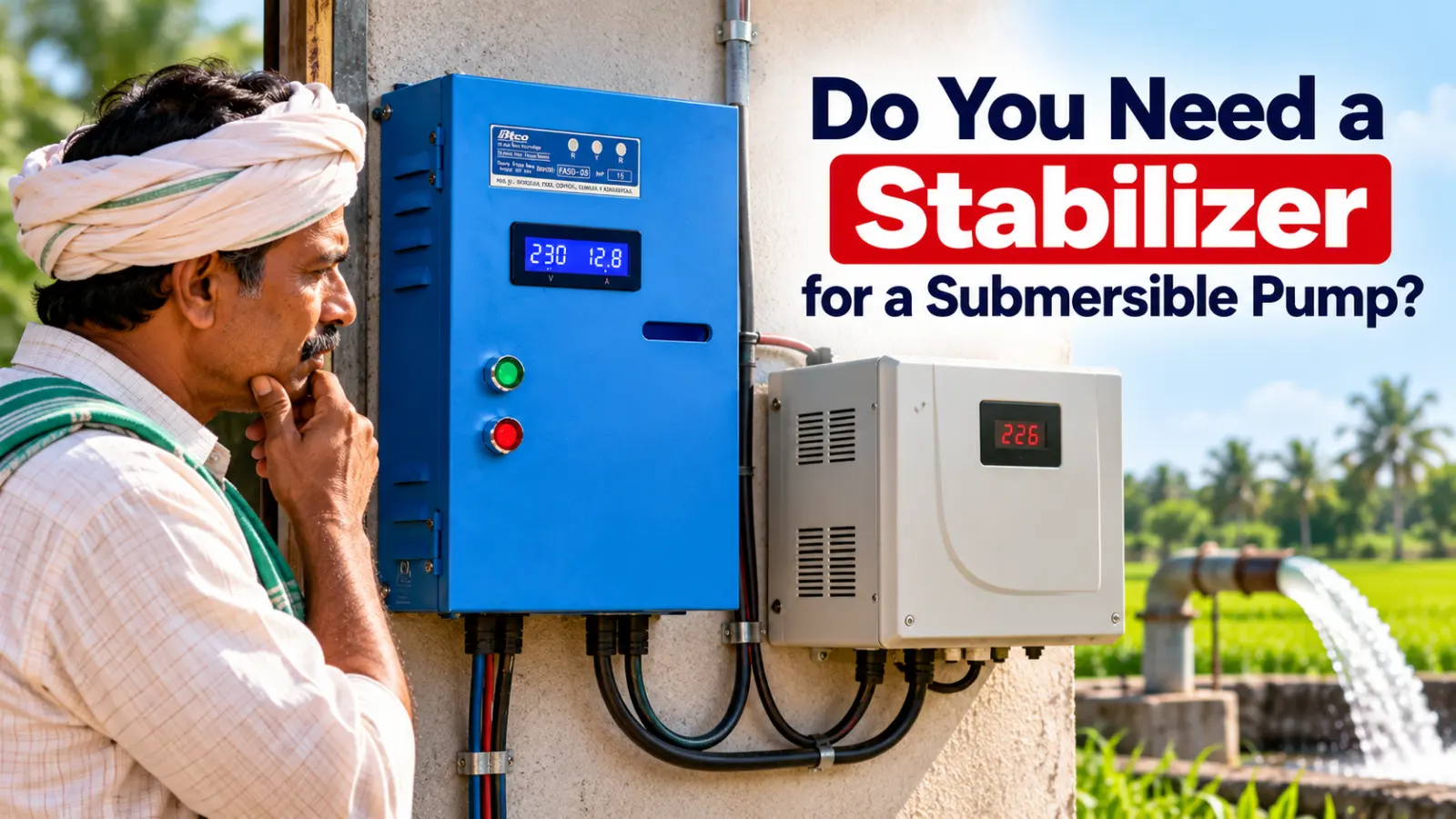
Low voltage in the evening, high voltage at night, and a motor that keeps burning. Many farmers are told to fit a stabilizer. Sometimes that helps, but a stabilizer alone does not stop a submersible motor from burning. Here is what voltage problems do to your motor, what a stabilizer can and can’t do, and the protection that matters most.
What bad voltage does to a submersible motor
- Low voltage: to do the same work, the motor pulls more current. More current means more heat in the winding. Hours of running like this cook the insulation, and the motor burns.
- High voltage: stresses the winding insulation and also heats the motor.
- Voltage that keeps going up and down (voltage fluctuation): common on long village lines and when every pump starts at the same time.
In every case, the real danger for the motor is the current going beyond its safe limit. That is the key to protecting it.
What a stabilizer does
A stabilizer tries to correct the incoming voltage and give the motor a steadier supply. For a single phase pump at home, on a line where the voltage stays a little high or low for long periods, a correctly sized stabilizer can help.
But a stabilizer has limits:
- It can only correct the voltage within its range. On a very weak line it cannot make up the difference.
- It does nothing about dry run, a jammed pump, a missing phase or a cable fault, which burn just as many motors as voltage does.
- An undersized or poor stabilizer can itself fail, and the motor keeps running without anyone knowing.
- For 3 phase farm motors, a stabilizer big enough for the motor is a large extra piece of equipment.
The protection that matters: a starter that trips on current
Whatever the voltage does, the motor burns only when the current stays too high for too long, or when it runs without water. A starter that watches the motor’s current all the time stops the motor before that happens:
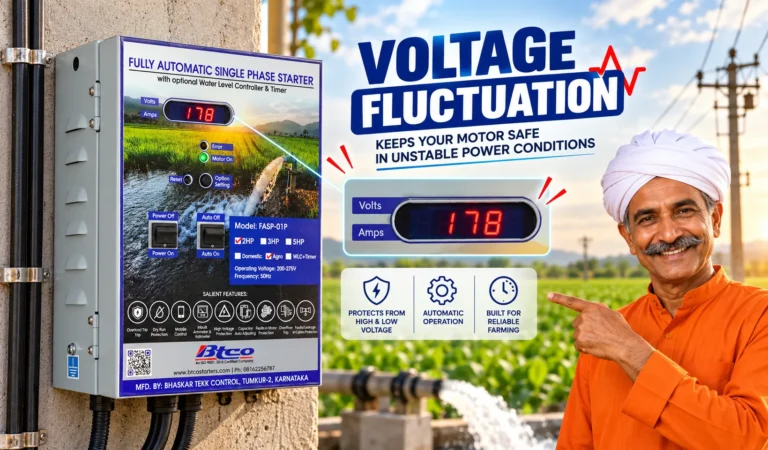
- Every BTCO starter trips on current. When voltage fluctuation pushes the motor’s current out of the safe range, the starter stops the motor. This is voltage fluctuation protection.
- The BTCO Single Phase starter also has separate low and high voltage protection, because single phase motors are the most sensitive to voltage.
- On 3 phase, every BTCO starter stops the motor at once if a phase goes missing (single phasing protection).
- Dry run and overload protection keep working at the same time.
Stabilizer or starter protection: a comparison
On a phone, swipe the table sideways.
| Problem | Stabilizer alone | BTCO starter |
|---|---|---|
| Low or high voltage | Corrects it within its range | Trips on current before the motor overheats; Single Phase starter also has low and high voltage cut-off |
| Voltage too low for the stabilizer to correct | Motor keeps running and heats up | Trips on current |
| One phase missing (3 phase) | No protection | Stops the motor at once (Mains Problem) |
| Borewell runs dry | No protection | Dry Run Trip, restarts after the dry restart time |
| Overload or jammed pump | No protection | Overload Trip |
| Earth leakage or cable fault | No protection | Ground / Imbalance, Check Cable / Kit |
So if you fit a stabilizer, still use a proper protecting starter. If you have to choose one, the starter protects against far more ways a motor can burn.
See the voltage before it hurts
A BTCO digital starter shows the voltage and current on each phase. Watch it for a few days: if the voltage drops sharply every evening, you’ll know when the motor is at risk, and you can run it at better hours with a timer. With the BTCO GSM Module, you can see the live voltage and current in the app from home.
Frequently asked questions
Do I need a stabilizer for my submersible pump?
A correctly sized stabilizer can help a single phase pump on a line where the voltage stays high or low for long periods. But it does not protect against dry run, a missing phase, overload or cable faults. A starter that trips on the motor’s current protects the motor in all these cases, so use a protecting starter whether or not you fit a stabilizer.
Can low voltage burn a submersible motor?
Yes. At low voltage the motor pulls more current to do the same work, heats up, and after hours of running the winding burns. A BTCO starter trips on current, so it stops the motor when the current goes beyond the safe range.
Does a BTCO starter protect against voltage fluctuation?
Yes. Every BTCO starter trips on the motor’s current, so when voltage fluctuation pushes the current out of the safe range, it stops the motor. The BTCO Single Phase starter also has separate low and high voltage protection.
Is a stabilizer useful for a 3 phase submersible motor?
For 3 phase farm motors, a stabilizer large enough is a big extra piece of equipment, and it does nothing about a missing phase, which is one of the most common causes of burning. A 3 phase starter with single phasing protection that trips on current is the essential protection.
How do I know if my voltage is too low?
Look at the voltage on your starter’s display, or in the BTCO app with the GSM Module. If it drops sharply at certain times, avoid running the motor then.
Protect your motor from voltage problems
Call or WhatsApp us with your motor’s HP, your supply and the voltage you usually see. We’ll suggest the right BTCO starter, or visit your nearest BTCO dealer. Read why submersible motors keep burning.
More videos on our videos page. Follow BTCO Starters on YouTube, Instagram and Facebook.