
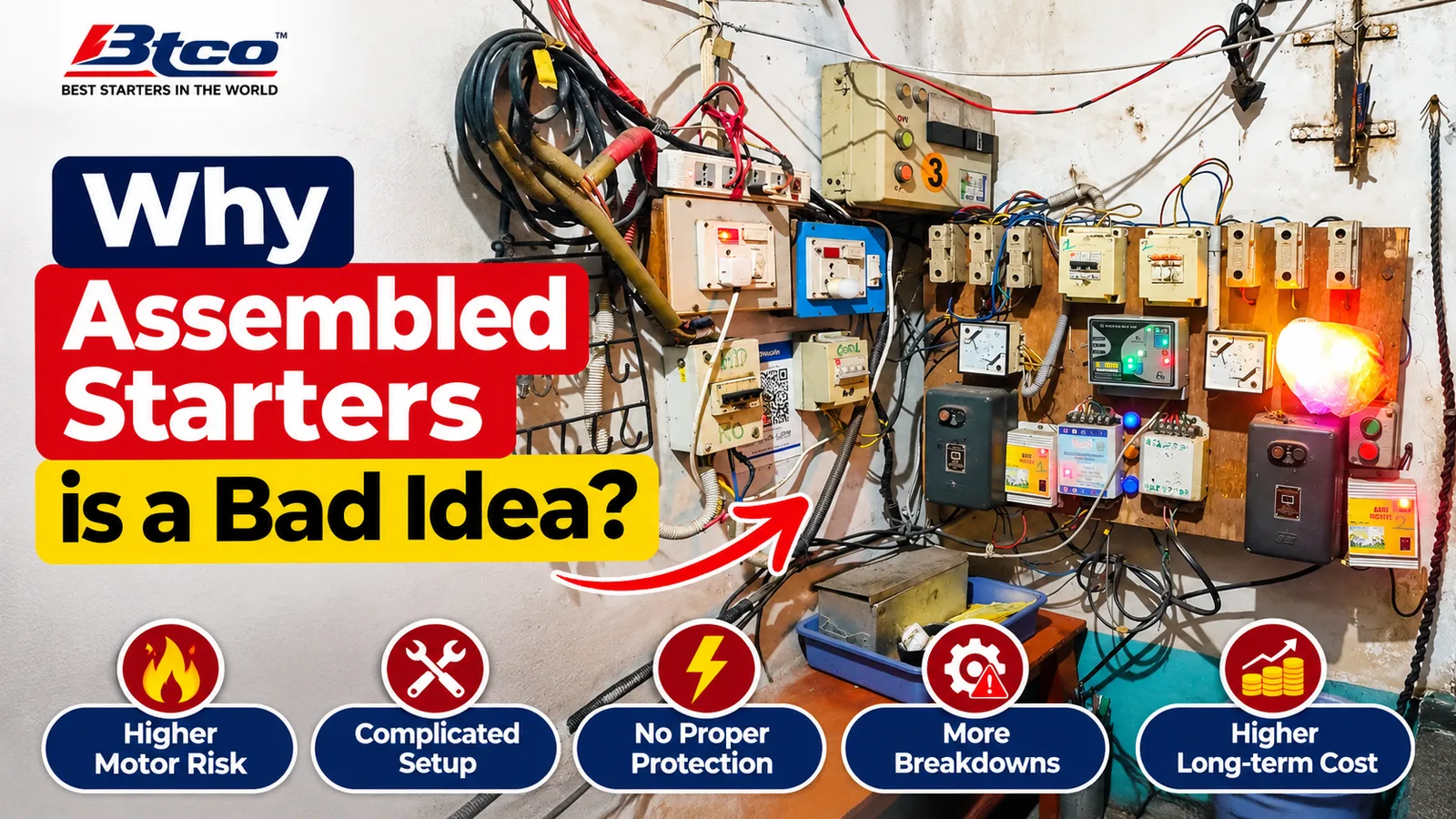
Someone who watched our video on Instagram sent us a photo of their starter board. An ON/OFF starter, an auto start unit, a single phase preventer, an overload relay, a dry run relay, a timer, and wires running between all of them. And with all of that on the wall, their submersible motor still kept getting damaged. This is one of the most common mistakes we see. Here is how it happens, why a board full of separate devices doesn’t stop motor burning, and the simpler way to protect your motor.
The short answer
- An assembled starter board (or panel board) is a basic ON/OFF starter with separate add-on devices fitted one by one: auto start units, single phase preventers, timers, motor protection relays, overload relays and dry run relays.
- Each device does its own small job, but they don’t work together. That leaves gaps in protection, makes the wiring complicated and costs more in the end.
- You don’t need a separate auto switch, phase preventer and relays. A fully automatic starter like a BTCO starter has auto start and all the main motor protections built into one unit, working together, so it is far better at stopping your motor from burning.
How a simple starter turns into a messy board
It usually happens step by step, over a few years:
- Day one: to save money, many farmers buy the cheapest starter, with only ON and OFF buttons. At that time it feels like enough.
- The first power cut: every time the power goes and comes back, someone has to walk to the field and press ON again. So an auto start unit (auto switch) is added.
- The first scare on the supply: the motor keeps running when a phase goes missing or the supply is bad. So a single phase preventer is added.
- The first burnt motor: the rewinder says it was overload, so an overload relay or a motor protection relay is added. Then the water level drops in summer, so a dry run relay goes in.
- Night power: to run the motor at fixed hours, a timer unit is added.
Before long, the wall has five or six boxes, often from different makers, joined by a tangle of wires. By then, more has been spent than a good starter would have cost, and the motor is still not safe.

Why a board full of separate devices still lets the motor burn
1. The devices don’t talk to each other
Each box only knows about its own job. The auto start unit doesn’t know why the motor stopped: was it a power cut, a dry run or an overload? It can switch the motor back on into the same fault, again and again. The relays each have their own settings, their own timing and their own idea of “safe”. Nobody is looking at the whole picture, so faults slip through the gaps between the boxes. A burnt motor is often the result.
2. More wires, more joints, more things to fail
Every extra device means more wires and more screw joints. A single loose joint can heat up, spark or drop a phase, which is exactly the kind of fault that burns motors. And if one device quietly fails, its protection is simply gone, and nobody notices until the motor is damaged.
3. You can’t tell why it tripped
When the motor stops, one small light comes on, on one of six boxes. Was it the phase preventer, the overload relay or the dry run relay? Without a clear reason, the usual “fix” is to reset it, turn a dial up or bypass a device “just to keep it running”, and the motor loses its protection.
4. Settings are guesses
Most add-on relays are set by turning a knob against a printed scale. Each one is set separately, often by a different electrician at a different time. The overload setting may no longer match the motor, the dry run setting may be too loose, and the timer may not know about any of them.
5. It costs more than it looks
Add up the starter, the auto start unit, the single phase preventer, the overload relay, the dry run relay, the timer, a bigger board, extra wiring and the electrician’s visits. Then add one rewinding bill, a crew to pull the pump, and days without water. The “cheap” starter turns out to be the expensive one.
Read more on why submersible motors keep burning, and how to stop it.
Do you need each of these devices separately?
These are the devices usually assembled on a starter board. Here is what each one does, and why you don’t need to buy it separately.
Auto start unit (auto switch) for a 3 phase motor
An auto start unit, often called an auto switch, is fitted to a starter so that the motor starts again by itself when power returns after a cut, and nobody has to walk to the field. Useful, but on its own it doesn’t know why the motor stopped, so it can switch the motor back on into a fault. A starter with auto start built in, like every BTCO starter, restarts only after the delay you set (with the auto switch ON) and waits the dry restart time after a dry run.
Looking for a 2/3 phase auto start unit because your village gets 2 phase or juice line part of the day? A BTCO Combined starter runs a 3 phase motor on 3 phase, 2 phase or juice line (up to 10 HP), with auto start and protection built in. See juice line explained.
Single phase preventer for a 3 phase motor and submersible pump
A single phase preventer (also called a single phasing preventer or SPP) is used to stop a 3 phase motor when one phase goes missing, for example from a blown fuse or a cut wire. It works by watching all three phases and cutting off the starter when one fails. A motor running on two phases can burn in minutes, so this protection is a must. Every BTCO 3 phase starter has it built in: it stops the motor at once and shows Mains Problem. See single phasing protection.
Overload relay and motor protection relay: what they do
An overload relay protects the motor by tripping when the motor draws too much current, from a jammed pump, worn bearings or low voltage. Older ones are bimetal relays set by turning a dial (see why that is a guess). Overload relays usually trip because the motor really is working too hard, or because the setting doesn’t match the motor’s rated amps. A motor protection relay usually combines a few protections in one box, sometimes with a display. A BTCO starter has overload protection set in exact amps, plus imbalance, grounding, cable fault and voltage fluctuation protection, all in the same unit.
Dry run protection relay for a submersible pump
A dry run relay works by watching the motor’s current: when the pump runs out of water, the current drops, and the relay stops the motor. Dry running is one of the biggest reasons submersible motors burn in summer. Every BTCO starter has dry run protection built in, and it works together with auto start: after a dry run trip it waits the dry restart time you set, then tries again.
Timer for a submersible pump
A timer runs the motor at fixed hours or in on/off cycles. BTCO timer + WLC variants and the Single Phase Domestic starter have normal, cyclic and RTC timers built in, and after a power cut the timer carries on with only the balance time.
Water level controller for a submersible pump
A water level controller starts the motor when the tank is low and stops it when the tank is full or the sump is empty. On an assembled board it is one more box with its own sensors and wiring. The BTCO timer + WLC variants and the Single Phase Domestic starter have the water level controller built in.
Single phase preventer with auto start? Get a starter that has both
Many people search for a single phase preventer with auto start, or a 3 phase starter with a single phasing preventer, because they want one device instead of two. That is exactly what a fully automatic starter is. A BTCO starter combines auto start, single phasing protection, overload and dry run protection, and more, in one unit, so you don’t need to wire a separate auto switch, SPP and relays to your starter.
One BTCO starter does the job of all those boxes
Every BTCO starter is a fully automatic starter. Instead of separate auto start units, single phase preventers, overload relays and dry run relays, it has everything built into one unit:
| On an assembled board | Built into a BTCO starter |
|---|---|
| Auto start unit (auto switch) | Auto start when power returns, after the delay you set (with the auto switch ON) |
| Single phase preventer | Single phasing protection: stops at once and shows Mains Problem |
| Overload relay / motor protection relay | Overload protection, set in exact amps |
| Dry run relay | Dry run protection, with a dry restart time you set |
| Voltage relay | Voltage fluctuation protection: trips on current when a voltage swing pushes it out of the safe range |
| Separate earth leakage device | Grounding protection and phase imbalance protection |
| Nothing | Cable side fault and supply side fault protection |
| Timer unit | Normal, cyclic and RTC timers on the timer + WLC variants and the Single Phase Domestic starter |
| Water level controller | Built-in water level control on the timer + WLC variants and the Single Phase Domestic starter |
| Separate mobile starter | Phone control by app and SMS with the BTCO GSM Module |
On a phone, swipe the table sideways.
What a panel board for a submersible pump should have
Whether you call it a starter, a panel board or a control panel, a good one for a submersible pump should have, in one unit: auto start, dry run protection, overload protection, single phasing protection, voltage fluctuation protection, grounding protection, a display that shows volts and amps, and a clear reason for every trip. Timers, water level control and phone control are useful extras.
Why “all in one” protects your motor better
- Everything works together. One brain reads the volts and amps on every phase and makes every decision. Auto start knows why the motor stopped, so it waits after a dry run (the dry restart time) instead of restarting straight into a fault.
- Clear reasons. The display tells you in words why it stopped, such as Dry Run Trip, Overload Trip, Mains Problem, Ground/Imbalance or Check Cable/Kit. See what each message means.
- Exact settings, in one place. Overload amps, auto start delay and dry restart time are set in numbers on one display. The 3 phase and Combined starters even learn your motor’s healthy amps the first time they are connected.
- Simple wiring. One starter, far fewer joints, far fewer things to go wrong, and a much neater board.
- One warranty, one dealer. One product to service instead of six boxes from different makers.
- Lower total cost. Less spent on add-ons, wiring and repairs, and far fewer burnt motors.
Don’t buy the cheapest starter. Buy the complete one.
A basic ON/OFF starter only switches the motor. It doesn’t protect it. Motor protection is not an extra: it is an investment that pays back the first time it stops a dry run or a missing phase.
If you are buying a new starter, choose a complete one from the start. If you already have a board full of separate devices and your motor keeps getting damaged, it may be time to replace the whole board with one starter. Ask your BTCO dealer to look at your setup.
Please note: what add-on devices can do varies from model to model. This is general information, not a review of any particular product. Check your own setup with your dealer, who has practical motor knowledge, and make the final decision yourself.
Which BTCO starter do you need?
- 3 phase, single cable motor, 3–10 HP: DOL starter.
- 3 phase, double cable motor, 7.5–30 HP: Star Delta starter.
- 3 phase motor on juice line, 2 phase or 3 phase: Combined starter.
- Single phase motor, 2–5 HP: Single Phase starter.
Not sure? The starter finder picks the right one in a few questions. BTCO starters work with submersible motors of all brands. Still using an old oil starter? Read oil starter vs analog vs digital starter.
Frequently asked questions
What is an auto start unit?
An auto start unit (also called an auto switch) is an add-on that starts the motor again when power returns after a cut. Every BTCO starter has auto start built in: it starts the motor by itself after the delay you set, as long as its auto switch is ON.
Do I need a separate single phase preventer with my starter?
Not with a BTCO starter. Every BTCO 3 phase starter has single phasing protection built in: it stops the motor at once when a phase goes missing and shows Mains Problem.
Do I need a separate auto switch for my submersible pump?
Not if your starter has auto start built in. Every BTCO starter starts the motor by itself when power returns, after the delay you set (with the auto switch ON), and waits the dry restart time after a dry run instead of restarting into a fault.
What is the difference between an overload relay and a dry run relay?
An overload relay stops the motor when it draws too much current, for example from a jammed pump or low voltage. A dry run relay stops it when the pump runs without water and the current drops. A BTCO starter has both protections built in, along with single phasing and voltage fluctuation protection.
What should a panel board for a submersible pump have?
Auto start, dry run, overload, single phasing, voltage fluctuation and grounding protection in one unit, a display of volts and amps, and a clear reason for every trip. Timers, water level control and phone control are useful extras.
What is a single phase preventer used for?
It is used to stop a 3 phase motor when one of the three phases goes missing. A motor left running on two phases draws very high current and can burn in minutes. Every BTCO 3 phase starter has single phasing protection built in and shows Mains Problem when a phase is missing.
How does dry run protection work?
When a submersible pump runs out of water, the motor’s current drops. Dry run protection watches for that drop and stops the motor. A BTCO starter then waits the dry restart time you set and tries again, so the motor runs as soon as the borewell has recovered.
Is there a single phase preventer with auto start in one unit?
Yes. A fully automatic starter does both. Every BTCO 3 phase starter has auto start and single phasing protection built in, along with overload, dry run and voltage fluctuation protection.
Why does my motor still burn when I have a phase preventer, overload relay and dry run relay?
Separate devices each do one job and don’t work together. The auto start unit doesn’t know why the motor stopped, settings are made separately by knob, and the extra wiring adds loose joints. Faults slip through the gaps, and the motor can still burn.
Is an assembled starter board cheaper than a fully automatic starter?
The basic starter is cheaper on day one. But after adding an auto start unit, a single phase preventer, an overload relay, a dry run relay, a timer, a bigger board and extra wiring, it usually costs more, and it still protects the motor less well.
What protections are built into a BTCO starter?
Auto start, dry run, overload, single phasing (Mains Problem), voltage fluctuation (it trips on current), grounding protection, phase imbalance, cable side fault and supply side fault protection. Timers and water level control come on the timer + WLC variants and the Single Phase Domestic starter.
Can I control a BTCO starter from my phone?
Yes. With the BTCO GSM Module you can switch the motor ON or OFF, check volts and amps and get trip alerts by app or SMS.
Do BTCO starters work with all motor brands?
Yes. BTCO starters work with single phase and three phase submersible motors of all brands.
Think long term. Choose BTCO.
Send us a photo of your starter board, or tell us your motor’s HP, single or double cable, and your power supply. We’ll tell you which BTCO starter replaces it. Or visit your nearest BTCO dealer.
More videos on our videos page. Follow BTCO Starters on YouTube, Instagram and Facebook.