
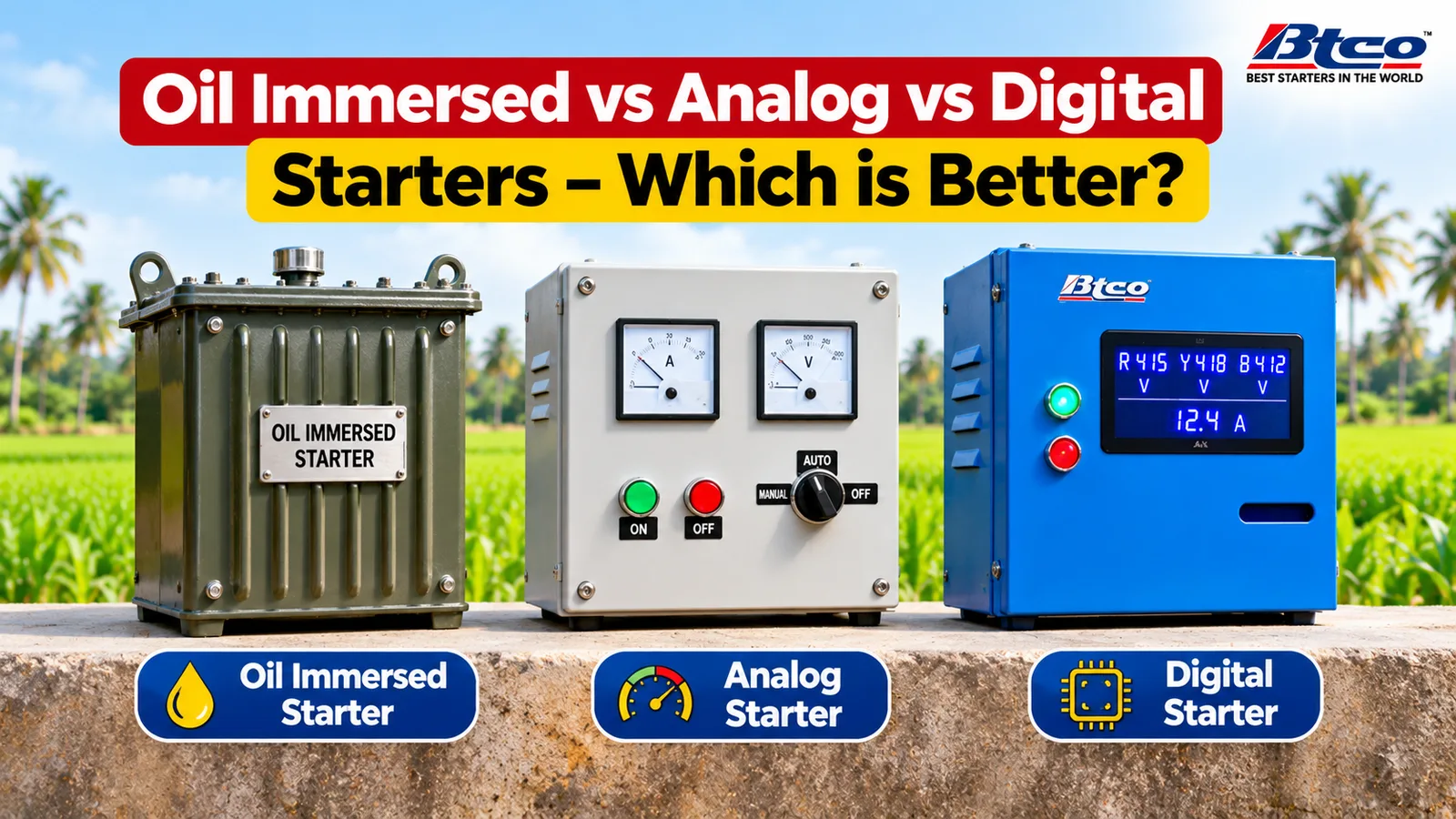
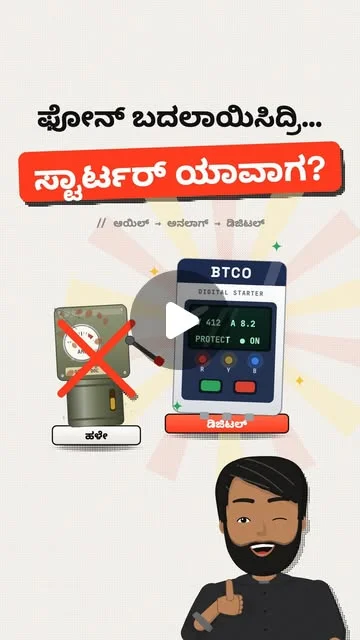
Many borewells still run on an oil starter (the “oil wala starter”) or an older analog panel with needle meters and knobs. They switch the motor on and off well enough. But most submersible motors burn because of things these starters cannot see: the pump running dry, one phase going missing, the current slowly creeping up. A digital starter measures all of this all the time and switches the motor off before it burns. Here is a plain comparison of the three, so you can decide what your motor needs.
The short answer
- Oil starter: a simple ON/OFF switch with a heat-based overload relay. It gives very little protection against the things that burn submersible motors, and it needs oil and contact upkeep.
- Analog starter: a better panel with meters, lights and dial settings. Some protect against dry run or a missing phase, but settings are guesses on a knob, and it can’t tell you why it stopped.
- Digital starter: measures the volts and amps on every phase, protects against dry run, overload, single phasing, imbalance, cable faults and voltage fluctuation, restarts the motor by itself, and shows the reason for every trip. This is the one that does the most to stop motor burning.
What is an oil starter?
An oil starter (also called an oil immersed starter or oil type DOL starter) is the old metal box with a green ON button and a red OFF button. Inside, the switch contacts and the no-volt coil sit in a tank of transformer oil, usually a few litres. The oil cools the coil and puts out the spark each time the contacts open.
Its protection comes from two parts:
- A bimetal (thermal) overload relay. A bimetallic strip heats up with the motor’s current and bends to trip the starter. You set it by turning a dial.
- The no-volt coil. When the power goes, the coil lets go and the motor stops. When the power comes back, the motor stays off until someone walks to the field and presses ON again.
That is all. An oil starter has no display, no dry run protection, and no way to tell you what went wrong. With so little protection, the chance of the motor burning goes up sharply, especially in summer, when water levels drop and the supply is weak. Many farmers add a separate single phasing preventer and an auto switch to their oil starter, which means more wiring, more boxes and more joints that can fail.
What is an analog starter?
An analog starter is the step between the two: an air-break panel with a contactor, an overload relay (thermal or electronic) and often a needle voltmeter and ammeter, sometimes with a selector switch to read one phase at a time. Many have an electronic card with LED lights and knobs to set dry run or overload.
It is better than an oil starter. But:
- Settings are made by turning a knob against a printed scale. You never know the exact amps it will trip at.
- The meters show a reading, but they don’t act on it. Someone has to be standing there to notice a problem.
- When it trips, a light comes on. It doesn’t say whether it was dry run, overload or the supply, so the next step is a guess.
What is a digital starter?
A digital starter has a microcontroller and a digital display. It reads the voltage and current on every phase, all the time, compares them with the safe limits you set in exact numbers, and stops the motor the moment something goes wrong. Then it tells you why, in words, such as Dry Run Trip or Mains Problem.
Every BTCO starter is a fully automatic digital starter. The 3 phase and Combined starters even learn your motor’s healthy amps the first time they are connected.
Oil vs analog vs digital starter at a glance
On a phone, swipe the table sideways.
| Oil starter | Analog starter | Digital starter (BTCO) | |
|---|---|---|---|
| Dry run protection | No | On some models, set by knob | Yes, stops the motor when the current drops |
| Overload protection | Bimetal relay, slow, affected by heat around it | Thermal or electronic relay, set by dial | Yes, set in exact amps |
| Single phasing (missing phase) | No; the bimetal relay may react late or not at all on a lightly loaded motor | On some models | Yes, stops at once and shows Mains Problem |
| Phase imbalance and earth leakage | No | Rarely | Yes (Ground/Imbalance) |
| Cable or winding fault | No | No | Yes (Check Cable/Kit) |
| Voltage fluctuation | No | Some models, separate cut-off | Yes, trips on current when a voltage swing pushes it out of the safe range |
| Shows volts and amps | No | Needle meters, often one phase at a time | All three phases at once, in numbers |
| Tells you why it tripped | No | A light at most | In words, on the display |
| Restarts after a power cut | No, someone must press ON | Only with an added auto switch | Yes, after a delay you set (auto switch ON) |
| Timer and water level control | No | Separate add-ons | On the timer + WLC variants and the Single Phase Domestic starter |
| Phone control | No | No | Yes, with the BTCO GSM Module and app |
| Upkeep | Oil top-up and change, contact (patti) and coil replacement | Relay and meter checks | Set it up once; keep the box dry and closed |
Why oil and analog starters let motors burn
A submersible motor sits deep in the borewell and is cooled by the water flowing past it. It burns when its winding gets too hot for too long. The common causes, and what each starter does about them:
1. Dry run: the starter that “sees nothing”
When the water level drops below the pump, the motor keeps spinning with no water to pump, and no water to cool it. Its current actually goes down, not up. A bimetal overload relay only trips on high current, so in an oil starter it stays quiet while the motor overheats. A digital starter watches for exactly this drop in current and stops the motor. After the dry restart time you set, it tries again, so the motor runs as soon as the borewell has recovered. Read more on dry run protection.
2. Single phasing: minutes to burn
If one of the three phases goes missing (a blown fuse, a cut wire, a loose joint), a 3 phase motor keeps trying to run on two phases and pulls very high current in the remaining windings. A bimetal relay reacts to heat, so it is slow, and on a motor that isn’t fully loaded it may not trip at all. A digital starter sees the missing phase directly and stops the motor at once, showing Mains Problem. See single phasing protection.
3. Overload: the guess on the dial
Worn bearings, a jammed pump or sand in the borewell make the motor work harder and draw more current. An oil starter’s bimetal relay is set by turning a dial, and its trip point shifts with the temperature in the pump house, so it can trip too late on a hot summer afternoon, or too early and keep tripping until someone turns the dial up “just to keep it running”. A digital starter trips at the exact amps you set, whatever the weather. See overload protection.
4. Voltage fluctuation, imbalance and cable faults
Low voltage in the evening and high voltage at night push the motor’s current out of its safe range. BTCO digital starters trip on the motor’s current, so they protect against voltage fluctuation on every phase, and the Single Phase starter also has separate low and high voltage protection. They also catch one phase drawing much more than the others, current leaking to earth, and faults in the cable or winding: problems an oil starter can never see until the motor has already burnt.
5. Nobody is there to watch
Even the best meter only helps if someone is looking at it. A digital starter does the watching for you, day and night, and with the BTCO GSM Module sends the trip reason to your phone.
Every burnt motor means a rewinding bill, a crew to pull the pump out, and days without water. Read why submersible motors keep burning, and how to stop it.
Advantages of a digital starter
- Stops motor burning before it starts. Dry run, overload, single phasing, imbalance, earth leakage, cable faults and voltage fluctuation all stop the motor instead of burning it.
- Exact settings. Overload trip amps, auto start delay, dry restart time and star delta changeover time are set in numbers, not by guessing on a knob.
- You see your motor’s health. Volts and amps on every phase, all the time. Rising amps or falling voltage show up before they become a burnt motor. See what the display tells you.
- Tells you why it stopped. Messages like Dry Run Trip, Overload Trip, Mains Problem, Ground/Imbalance and Check Cable/Kit save a wasted trip and a wrong repair. All messages are explained in BTCO starter error messages.
- Fully automatic. When power returns, the motor starts by itself after the delay you set (with the auto switch ON), and a timer carries on with only the balance time. No walk to the field at night: see what fully automatic means.
- Timers and water level control on the timer + WLC variants and the Single Phase Domestic starter: see starter timers and the water level controller.
- Phone control. Add the BTCO GSM Module to switch the motor ON or OFF, check volts and amps and get trip alerts by app or SMS.
- One box instead of three. No separate single phasing preventer and auto switch, so fewer joints and less wiring to go wrong.
- No oil to change. No oil top-ups, no leaks, no carbon-black oil in the box.
Is a digital starter worth it?
A digital starter costs more than a basic oil starter. Compare that with the cost of one burnt motor: the rewinding bill, the crew to pull the pump, new cable joints and days without water, often in the hottest weeks when the crop needs it most. For most farmers, a digital starter pays for itself the first time it stops a dry run or a missing phase.
Two honest points: set it up once properly with your electrician or BTCO dealer (the overload amps should match your motor’s nameplate), and fit it where it stays dry and closed, like any electrical panel.
Please note: the oil and analog starter descriptions here are general information about common designs, gathered from online research. Individual models differ. Check the details of your own starter with your dealer, who has practical motor knowledge, and make the final decision yourself.
Which BTCO digital starter do you need?
- 3 phase, single cable motor, 3–10 HP: DOL starter.
- 3 phase, double cable motor, 7.5–30 HP: Star Delta starter.
- 3 phase motor on juice line, 2 phase or 3 phase: Combined starter. See juice line explained.
- Single phase motor, 2–5 HP: Single Phase starter.
Not sure about single or double cable? Read DOL vs star delta, or let the starter finder pick the right starter in a few questions. BTCO starters work with submersible motors of all brands.
Frequently asked questions
What is the difference between an oil starter and a digital starter?
An oil starter is a push-button ON/OFF switch with its contacts in oil and a heat-based (bimetal) overload relay. A digital starter measures the volts and amps on every phase all the time, protects the motor from dry run, overload, single phasing, imbalance, cable faults and voltage fluctuation, restarts it automatically after a power cut and shows the reason for every trip.
Does an oil starter have dry run protection?
No. A pump running dry draws less current, and an oil starter’s overload relay only trips on high current, so it does not stop the motor. Dry run protection needs a starter that watches for the current dropping, like a BTCO digital starter.
Which is better, an analog starter or a digital starter?
A digital starter. An analog starter shows readings on needle meters and is set with knobs, but it cannot tell you why it tripped. A digital starter is set in exact amps, shows all three phases at once and says in words what went wrong, such as Dry Run Trip or Mains Problem.
Can a digital starter stop my submersible motor from burning?
It removes the most common reasons motors burn. A BTCO digital starter stops the motor on dry run, overload, a missing phase, phase imbalance, earth leakage, cable faults and voltage fluctuation, before the winding overheats.
Why does my motor burn even though I have an oil starter?
An oil starter only protects against overload, through a bimetal relay that is slow and set by guesswork. It does not stop the motor on dry run, and it may react late or not at all to a missing phase. These are common reasons submersible motors burn, so with an oil starter the chance of burning is much higher.
Does an oil starter need maintenance?
Yes. The oil darkens with carbon from sparking and needs topping up or changing, and the contacts and no-volt coil wear and need replacing over time. A digital starter has no oil to change.
Does a digital starter start the motor automatically after a power cut?
Yes. A BTCO digital starter starts the motor by itself when power returns, after the delay you set, as long as its auto switch is ON. An oil starter stays off until someone presses ON.
Do BTCO digital starters work with all motor brands?
Yes. BTCO starters work with single phase and three phase submersible motors of all brands.
Replace your oil starter before the next burnt motor
Tell us your motor’s HP, single or double cable, and the power supply you get, and we’ll tell you which BTCO digital starter fits. Or visit your nearest BTCO dealer. More answers in our motor starter FAQ.
More videos on our videos page. Follow BTCO Starters on YouTube, Instagram and Facebook.