
A submersible motor rarely burns because of the motor. It burns because the starter didn’t stop it in time: when the borewell ran dry, when a phase went missing, when the current climbed too high. In 2027 there is no reason to buy a starter that can’t do that. This submersible pump starter buying guide gives you a 10-point checklist to use at the dealer’s counter: the protection to insist on, how to check the contactor rating for your motor’s HP, why oil starters and analog starters are a thing of the past, and why mobile control is now a must, not a luxury. Every point comes back to one goal: stopping your submersible motor from burning.
The 10-point checklist, in one minute
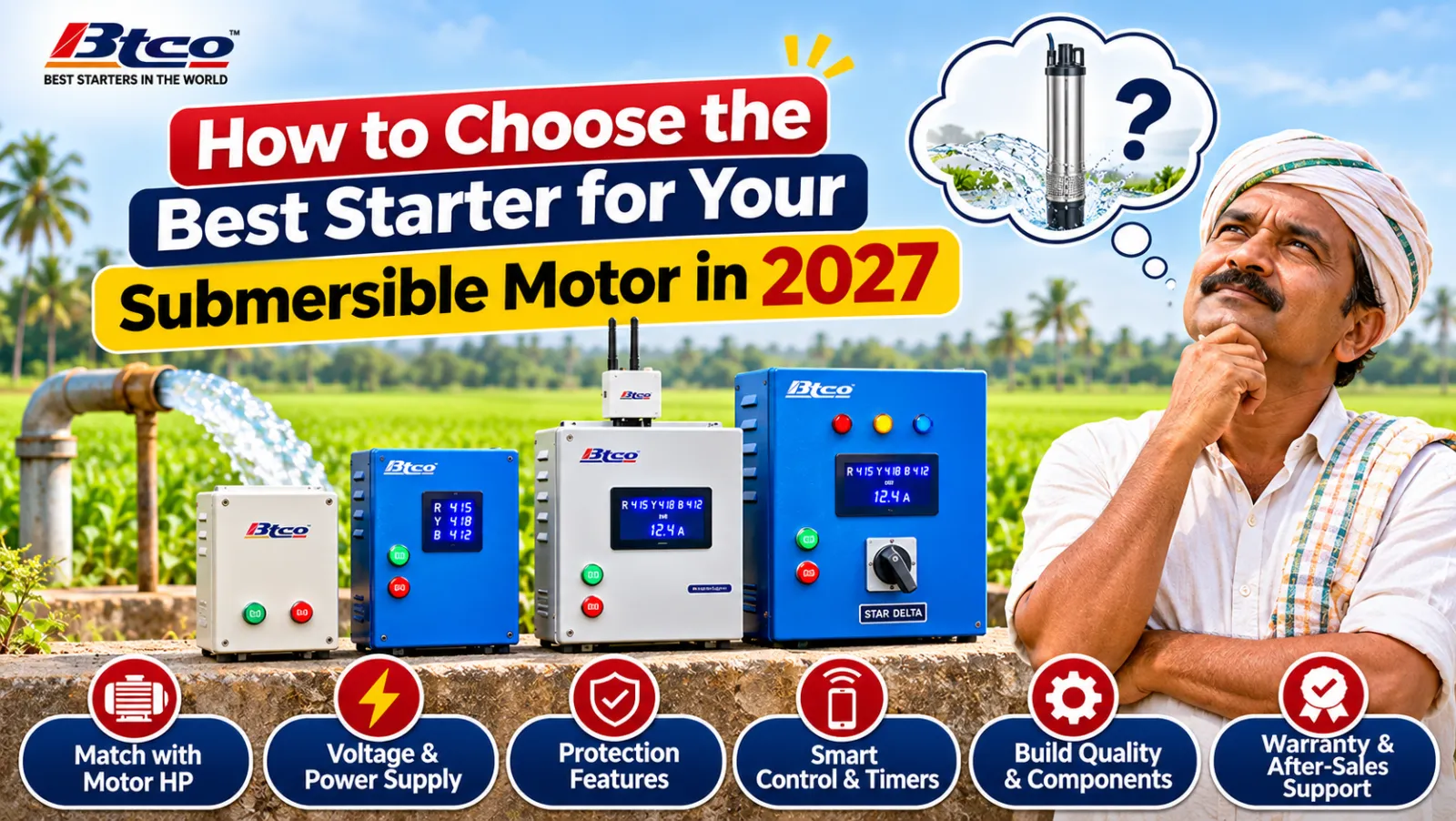
Take this list to the shop. A good starter for a submersible motor in 2027 should tick every box:
- 1. Digital and fully automatic, not an oil starter, an analog starter, or a basic ON/OFF box.
- 2. Dry run protection with an adjustable dry restart time.
- 3. Overload protection that matches your motor’s current.
- 4. Single phasing protection for a 3 phase motor.
- 5. Voltage fluctuation protection, plus grounding, phase imbalance and cable fault protection.
- 6. The right contactor rating for your motor’s HP and current.
- 7. Mobile control: switch the motor ON or OFF from your phone and get an alert on every trip.
- 8. A display that shows volts, amps and the trip reason.
- 9. One complete, factory-made unit, not a board of separate devices.
- 10. The right type for your motor and supply, with a dealer nearby for service.
Don’t want to read it all? Answer a few quick questions in our starter finder and it will tell you the right BTCO starter for your motor.
Why the starter decides whether your motor burns
A submersible motor sits deep in the borewell, cooled by the water flowing past it. It can’t tell you when something is wrong. The starter is the only thing watching it. When the water level drops, a phase goes missing, the voltage swings or the pump jams, the motor’s current changes within seconds. A protective starter sees that change and stops the motor before the winding overheats. A basic starter keeps it running until it burns.
And a burnt motor is expensive: a crew to pull the pump out, a rewinding bill, and days without water when your crop needs it most. A good starter costs far less than one rewinding. Read more on why submersible motors keep burning, and how to stop it.

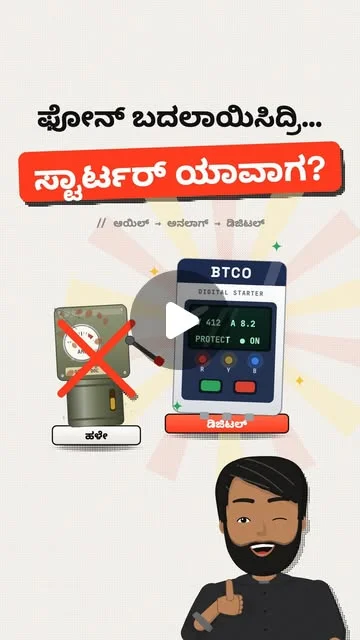
1. Choose digital: skip oil starters and analog starters
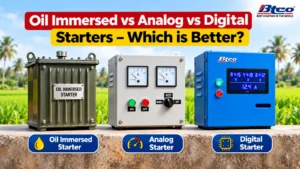
For years, farmers used oil starters, and later analog starters with a needle meter and a knob-set relay. Both can switch a motor on and off. Neither really protects it:
- An oil starter only switches the motor and has a basic thermal overload. It has no dry run protection, no single phasing protection, no automatic restart and no way to tell you why it tripped. The oil also needs regular checking and changing.
- An analog starter adds a meter and a few protections, but its settings are made by turning knobs against a printed scale. They drift, they get turned up “just to keep it running”, and the motor quietly loses its protection.
- A digital starter measures the motor’s current and voltage all the time, compares them with the settings for your motor, and stops the motor the moment something is wrong. It shows you the exact reason on its display.
In 2027, a digital, fully automatic starter is the sensible choice for a submersible pump. See the full comparison in oil starter vs analog starter vs digital starter, and what “fully automatic” really means.
2. Dry run protection: the one feature a borewell can’t do without
When the water in the borewell drops below the pump, the motor runs dry. Without water to cool it, it overheats fast. Dry run protection watches for the drop in current that happens when the pump runs out of water, and stops the motor straight away.
What to check: the starter should also restart by itself after a dry run, but only after a waiting time you set (the dry restart time), so the borewell has time to recover. A starter that restarts too soon just runs the motor dry again. Every BTCO starter has dry run protection with an adjustable dry restart time. More in dry run protection for submersible motors.
3. Overload protection that matches your motor
Overload protection stops the motor when it draws too much current for too long: a jammed or sand-locked pump, low voltage, a worn bearing. On old starters, the overload relay is set by hand with a knob, and it is often set too high, or turned up after a few nuisance trips. Then it no longer protects anything.
What to check: the overload setting must follow your motor’s rated current (the amps on its nameplate), not a guess. On BTCO starters, the overload setting is made automatically for your motor, so it doesn’t depend on someone turning a knob. Read why borewell motors trip on overload, and how to protect them.
4. Single phasing protection for every 3 phase motor
If one of the three phases goes missing (a blown fuse, a broken wire, a fault on the line), a 3 phase motor keeps trying to run on two. Its current shoots up and it can burn in minutes. Village supply makes this common.
What to check: the starter must stop the motor at once when a phase is missing, with no separate single phase preventer needed. Every BTCO 3 phase starter has single phasing protection built in and shows Mains Problem on its display. More in single phasing preventer for submersible motors.
5. Voltage fluctuation, grounding and cable fault protection
Rural voltage goes up and down through the day. When the voltage drops, the motor draws more current to do the same work and heats up. A good starter protects against this. BTCO starters trip on the motor’s current, so when a voltage swing pushes the current out of the safe range, they stop the motor. That is voltage fluctuation protection that looks at what actually harms the motor.
Also ask for:
- Grounding protection, for a leak to earth in the motor or cable.
- Phase imbalance protection, when the three phases are uneven.
- Cable side fault and supply side fault protection.
Every BTCO starter has all of these. The single phase BTCO starter also has separate low and high voltage protection. See every protection your borewell motor needs.
6. Check the contactor rating for your motor’s HP
The contactor is the heavy-duty switch inside the starter that actually connects your motor to the supply. It carries the motor’s full current every time it runs, and a much bigger current for a moment each time the motor starts. This is the part most buyers never look at, and one of the most important.
What happens when the contactor is too small for the motor:
- It heats up every time the motor runs.
- Its contacts pit and burn from the sparking at every start.
- Burnt contacts make a poor connection on one phase, so the motor gets uneven voltage or a missing phase: exactly the condition that burns a submersible motor.
- In the worst case, the contacts stick (weld) together, and the contactor can’t switch the motor off at all.
How to check the contactor rating:
- Note your motor’s HP and rated current from its nameplate or bill.
- Ask the dealer which contactor the starter uses and its current rating for motor duty, printed on the contactor’s label (often marked AC-3, the rating for starting and stopping motors).
- The contactor’s motor-duty rating should be comfortably above your motor’s rated current. Never pick a contactor just big enough on paper.
- A star delta starter uses three contactors (main, star and delta), and each must suit the motor.
- Buy a starter made for your motor’s HP range, not one “that will manage”. A starter built for a smaller motor has a smaller contactor.
Please note: this is general information, not a BTCO recommendation for a specific motor. Contactor choice depends on your motor and your site. Do your own research, check with your dealer (they know motors in practice), and make the final decision yourself.
BTCO starters are built for set HP ranges, with the contactors chosen for those motors in the factory, so you don’t have to match parts yourself. Tell us your motor’s HP and we’ll tell you which one fits.
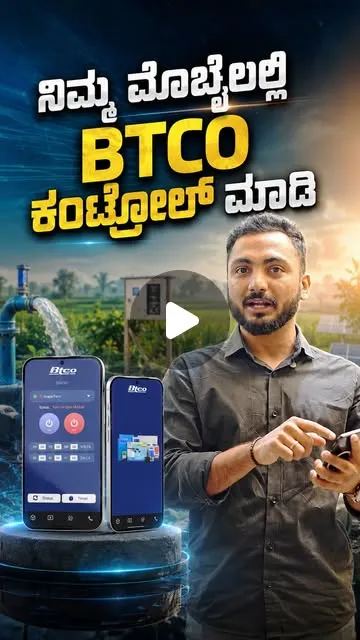
7. Mobile control: a must-have in 2027
Farm power often comes in shifts, sometimes at night. Without mobile control, someone has to walk to the borewell to switch the motor on, and walk back to check if it tripped. With a mobile starter you do it from your phone.
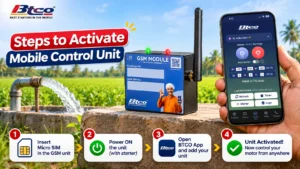
With the BTCO GSM Module fitted to your BTCO starter, you can:
- Switch the motor ON or OFF from the BTCO app or by SMS, from anywhere.
- See volts and amps and the motor’s status live.
- Get an alert for power cuts and every trip: Dry Run Trip, Overload Trip, Mains Problem and more, so you know what happened before you reach the field.
- Set timers from the app, and check the logs of motor run time and power cuts.
What to check: can the starter take mobile control, today or later? Every BTCO starter can, and the GSM Module can be added later to BTCO starters bought from January 2024 onwards. See what a mobile starter is, the BTCO app, and 8 things to check before you buy a mobile starter for a 3 phase motor.
8. A display that tells you why it tripped
When a starter stops the motor, you need to know why. Was the borewell dry? Was a phase missing? Was the pump jammed? A single red light can’t tell you, so the usual “fix” is to reset it and hope.
What to check: a digital display that shows the voltage on each phase, the motor’s current and a clear trip message. BTCO starters show messages like Dry Run Trip, Overload Trip, Mains Problem and Ground / Imbalance. Each one has an explanation in our starter error messages guide, with videos.
9. One complete starter, not a board of add-ons
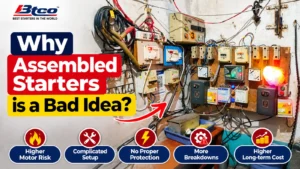
Many farmers start with the cheapest ON/OFF starter, then add an auto start unit, a single phase preventer, an overload relay, a dry run relay and a timer, one at a time, often screwed onto plywood. The devices don’t work together, the extra wiring adds loose joints, and nobody can tell which box tripped. Motors still burn.
What to check: buy one complete, factory-made and tested starter with auto start and every protection built in, working together. Read why an assembled starter still burns your motor.
10. The right type for your motor and supply, and service nearby
The best starter is still the wrong one if it doesn’t suit your motor. Check:
- Single cable or double cable? Single cable motors take a DOL starter. Double cable motors (from 7.5 HP) take a star delta starter. See DOL vs star delta.
- Your power supply. On juice line or 2 phase, you need a Combined starter. Juice line is safe only up to 10 HP.
- Single phase motor? Choose a single phase starter, with water level control and timers if you fill a home tank.
- Extras you will use: timers (normal, cyclic and RTC) and a water level controller come on the BTCO timer + WLC variants and the Single Phase Domestic starter.
- Service and warranty. Buy where there is a dealer near you, so help is close if you need it. See our warranty and sales and service centres.
Not sure which one? Our guide to which starter your submersible motor needs matches every motor and supply to the right model, or use the starter finder.
Which BTCO starter fits your motor?
| Your motor | Your supply | BTCO starter |
|---|---|---|
| 3 phase, single cable, 3–10 HP | 3 phase | DOL-03 fully automatic DOL starter |
| 3 phase, double cable, 7.5–30 HP | 3 phase | FASD-03 fully automatic star delta starter |
| 3 phase, single cable, 3–10 HP | Juice line, 2 phase or 3 phase | DOL-2/3 Combined juice starter |
| 3 phase, double cable, 7.5–25 HP | 2 phase or 3 phase (juice line up to 10 HP) | FASD-2/3 Combined star delta starter |
| Single phase, 2–5 HP | Single phase | FASP-01 single phase starter |
| You already have a 3 phase starter | 3 phase | MPAU digital auto start unit adds the protection |
Add the GSM Module to any of them for mobile control. BTCO starters work with motors of every brand, so choose by your motor’s HP, phase and cable, not the pump brand. See all models on our submersible pump starters page.
Mistakes to avoid when buying a starter in 2027
- Choosing on price alone. The cheapest starter usually has the least protection. One burnt motor costs more than the difference.
- Not opening the box. Ask to see the contactor and its rating. A contactor too small for the motor is a common reason starters fail.
- Buying an oil starter or analog starter “because it’s simple”. Simple to buy, but it won’t stop a dry run or a missing phase.
- Skipping mobile control to save money. Check at least that the starter can take a mobile control unit later.
- Matching the starter to your neighbour’s motor. Match it to yours: HP, phase, cable and supply.
Why farmers choose BTCO
BTCO has made motor starters in Tumakuru, Karnataka since 1992. Our starters have been chosen by more than 2,00,000 customers and protect over 6,58,000 motors, and we are ISO 9001:2015 certified. Every BTCO starter is digital and fully automatic, with dry run, overload, single phasing (3 phase), voltage fluctuation, grounding, phase imbalance, cable side fault and supply side fault protection built in, all designed to help stop your submersible motor from burning. Watch how they work on our videos page, or download the brochures.
Frequently asked questions
How do I choose a starter for a submersible motor?
Match the starter to your motor’s HP, phase and cable (single or double) and to your power supply. Then check that it is digital and fully automatic, with dry run, overload, single phasing and voltage fluctuation protection, a contactor rated comfortably above your motor’s current, a display that shows the trip reason, and mobile control.
Which is the best starter for a submersible pump in 2027?
A digital, fully automatic starter that suits your motor and supply and has every main protection built in: dry run, overload, single phasing, voltage fluctuation, grounding and cable fault protection, plus mobile control. Every BTCO starter has these protections, and the BTCO GSM Module adds phone control.
Is an oil starter good for a submersible pump?
An oil starter can switch a motor on and off, but it has no dry run protection, no single phasing protection, no automatic restart and no trip reason. A digital starter protects a submersible motor far better.
What contactor rating do I need for my motor?
The contactor’s rating for motor duty (often marked AC-3 on its label) should be comfortably above your motor’s rated current from its nameplate. The right size depends on your motor and site, so check with your dealer. BTCO starters come with contactors chosen in the factory for their HP range.
What happens if the contactor is too small for the motor?
It overheats, its contacts pit and burn, and it can give the motor uneven voltage or a missing phase, which can burn the motor. In the worst case the contacts stick and the motor can’t be switched off.
Is dry run protection necessary for a borewell motor?
Yes. When the borewell water drops below the pump, the motor runs dry and overheats. Dry run protection stops it at once and, on a BTCO starter, restarts it after the dry restart time you set.
Is a mobile starter worth it?
For most farmers, yes. You can switch the motor ON or OFF from the app or by SMS, see volts and amps, and get an alert for power cuts and every trip, so you don’t have to walk to the borewell at night.
Can I add mobile control to my existing BTCO starter?
Yes. The BTCO GSM Module can be added later to BTCO starters bought from January 2024 onwards. For older starters, check with BTCO or your dealer first.
What is the difference between an automatic starter and a normal starter?
A normal starter only switches the motor on and off. A fully automatic starter starts the motor by itself when power returns (after the delay you set, with its auto switch ON) and stops it when there is a dry run, overload, missing phase or other fault.
Do I need a separate single phase preventer and dry run relay?
Not with a BTCO starter. Single phasing protection (on 3 phase starters) and dry run protection are built in, along with overload and voltage fluctuation protection, so no add-on devices are needed.
Which starter is best for a 7.5 HP or 10 HP submersible pump?
A 7.5 HP or 10 HP motor can be single or double cable. Single cable takes the BTCO DOL-03; double cable takes the FASD-03 star delta starter. On juice line or 2 phase, use the matching Combined starter.
Do BTCO starters work with all pump brands?
Yes. BTCO starters work with submersible motors of all brands. Choose by the motor’s HP, phase and cable.
Ready to choose? Start with the finder
Answer a few quick questions in the BTCO starter finder, or call us with your motor’s HP, single or double cable, and your power supply. We’ll tell you the right starter. You can also visit your nearest BTCO dealer.
More videos on our videos page. Follow BTCO Starters on YouTube, Instagram and Facebook.